


Page 473 - Python Data Science Handbook
P. 473
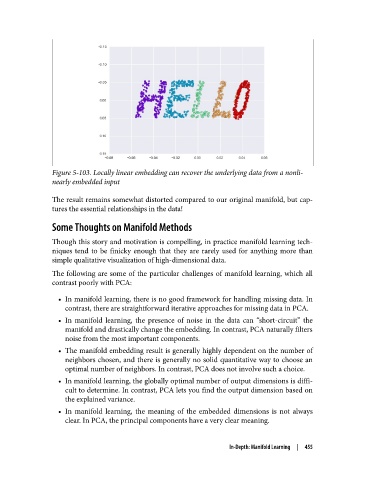
Figure 5-103. Locally linear embedding can recover the underlying data from a nonli‐
               nearly embedded input


               The result remains somewhat distorted compared to our original manifold, but cap‐
               tures the essential relationships in the data!

               Some Thoughts on Manifold Methods

               Though this story and motivation is compelling, in practice manifold learning tech‐
               niques tend to be finicky enough that they are rarely used for anything more than
               simple qualitative visualization of high-dimensional data.
               The following are some of the particular challenges of manifold learning, which all
               contrast poorly with PCA:

                 • In manifold learning, there is no good framework for handling missing data. In
                   contrast, there are straightforward iterative approaches for missing data in PCA.
                 • In manifold learning, the presence of noise in the data can “short-circuit” the
                   manifold and drastically change the embedding. In contrast, PCA naturally filters
                   noise from the most important components.

                 • The manifold embedding result is generally highly dependent on the number of
                   neighbors chosen, and there is generally no solid quantitative way to choose an
                   optimal number of neighbors. In contrast, PCA does not involve such a choice.
                 • In manifold learning, the globally optimal number of output dimensions is diffi‐
                   cult to determine. In contrast, PCA lets you find the output dimension based on
                   the explained variance.
                 • In manifold learning, the meaning of the embedded dimensions is not always
                   clear. In PCA, the principal components have a very clear meaning.


                                                                In-Depth: Manifold Learning  |  455

