


Page 478 - Python Data Science Handbook
P. 478
We could then go on to classify this data, perhaps using manifold features as inputs to
               the classification algorithm as we did in “In-Depth: Support Vector Machines” on
               page 405.
               Example: Visualizing Structure in Digits

               As another example of using manifold learning for visualization, let’s take a look at
               the MNIST handwritten digits set. This data is similar to the digits we saw in “In-
               Depth: Decision Trees and Random Forests” on page 421, but with many more pixels
               per image. It can be downloaded from http://mldata.org/ with the Scikit-Learn utility:

                   In[22]: from sklearn.datasets import fetch_mldata
                           mnist = fetch_mldata('MNIST original')
                           mnist.data.shape
                   Out[22]: (70000, 784)
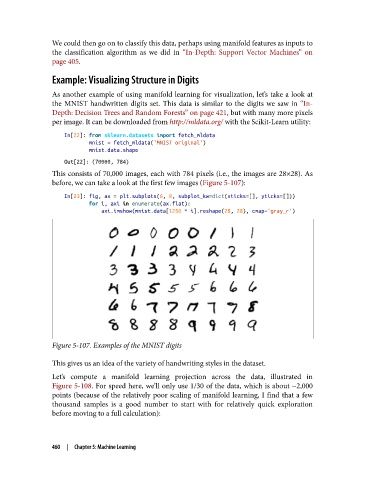
               This consists of 70,000 images, each with 784 pixels (i.e., the images are 28×28). As
               before, we can take a look at the first few images (Figure 5-107):
                   In[23]: fig, ax = plt.subplots(6, 8, subplot_kw=dict(xticks=[], yticks=[]))
                           for i, axi in enumerate(ax.flat):
                               axi.imshow(mnist.data[1250 * i].reshape(28, 28), cmap='gray_r')


               Figure 5-107. Examples of the MNIST digits

               This gives us an idea of the variety of handwriting styles in the dataset.
               Let’s compute a manifold learning projection across the data, illustrated in
               Figure 5-108. For speed here, we’ll only use 1/30 of the data, which is about ~2,000
               points (because of the relatively poor scaling of manifold learning, I find that a few
               thousand samples is a good number to start with for relatively quick exploration
               before moving to a full calculation):


               460  |  Chapter 5: Machine Learning

