


Page 480 - Python Data Science Handbook
P. 480
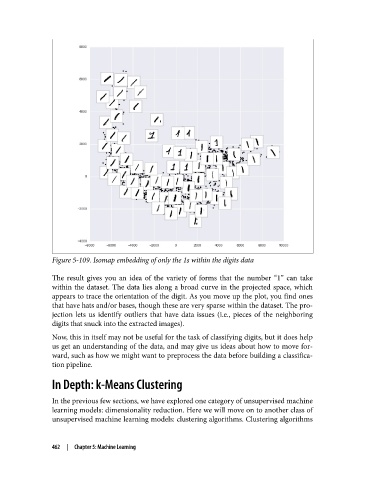
Figure 5-109. Isomap embedding of only the 1s within the digits data

               The result gives you an idea of the variety of forms that the number “1” can take
               within the dataset. The data lies along a broad curve in the projected space, which
               appears to trace the orientation of the digit. As you move up the plot, you find ones
               that have hats and/or bases, though these are very sparse within the dataset. The pro‐
               jection lets us identify outliers that have data issues (i.e., pieces of the neighboring
               digits that snuck into the extracted images).
               Now, this in itself may not be useful for the task of classifying digits, but it does help
               us get an understanding of the data, and may give us ideas about how to move for‐
               ward, such as how we might want to preprocess the data before building a classifica‐
               tion pipeline.

               In Depth: k-Means Clustering

               In the previous few sections, we have explored one category of unsupervised machine
               learning models: dimensionality reduction. Here we will move on to another class of
               unsupervised machine learning models: clustering algorithms. Clustering algorithms


               462  |  Chapter 5: Machine Learning

