


Page 488 - Python Data Science Handbook
P. 488
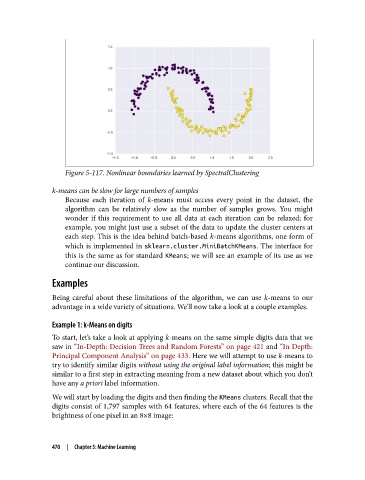
Figure 5-117. Nonlinear boundaries learned by SpectralClustering

               k-means can be slow for large numbers of samples
                   Because each iteration of k-means must access every point in the dataset, the
                   algorithm can be relatively slow as the number of samples grows. You might
                   wonder if this requirement to use all data at each iteration can be relaxed; for
                   example, you might just use a subset of the data to update the cluster centers at
                   each step. This is the idea behind batch-based k-means algorithms, one form of
                   which is implemented in sklearn.cluster.MiniBatchKMeans. The interface for
                   this is the same as for standard KMeans; we will see an example of its use as we
                   continue our discussion.

               Examples
               Being careful about these limitations of the algorithm, we can use k-means to our
               advantage in a wide variety of situations. We’ll now take a look at a couple examples.

               Example 1: k-Means on digits
               To start, let’s take a look at applying k-means on the same simple digits data that we
               saw in “In-Depth: Decision Trees and Random Forests” on page 421 and “In Depth:
               Principal Component Analysis” on page 433. Here we will attempt to use k-means to
               try to identify similar digits without using the original label information; this might be
               similar to a first step in extracting meaning from a new dataset about which you don’t
               have any a priori label information.

               We will start by loading the digits and then finding the KMeans clusters. Recall that the
               digits consist of 1,797 samples with 64 features, where each of the 64 features is the
               brightness of one pixel in an 8×8 image:


               470  |  Chapter 5: Machine Learning

