


Page 487 - Python Data Science Handbook
P. 487
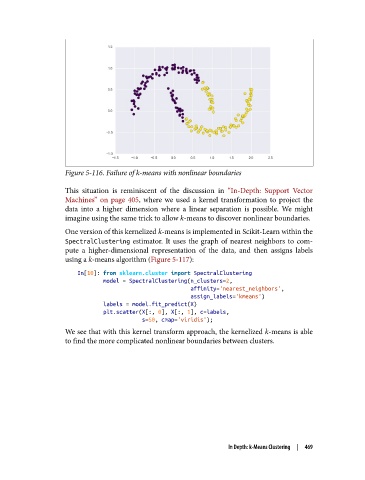
Figure 5-116. Failure of k-means with nonlinear boundaries

                   This situation is reminiscent of the discussion in “In-Depth: Support Vector
                   Machines”  on page 405, where we used a kernel transformation to project the
                   data into a higher dimension where a linear separation is possible. We might
                   imagine using the same trick to allow k-means to discover nonlinear boundaries.
                   One version of this kernelized k-means is implemented in Scikit-Learn within the
                   SpectralClustering  estimator. It uses the graph of nearest neighbors to com‐
                   pute a higher-dimensional representation of the data, and then assigns labels
                   using a k-means algorithm (Figure 5-117):
                      In[10]: from sklearn.cluster import SpectralClustering
                              model = SpectralClustering(n_clusters=2,
                                                         affinity='nearest_neighbors',
                                                         assign_labels='kmeans')
                              labels = model.fit_predict(X)
                              plt.scatter(X[:, 0], X[:, 1], c=labels,
                                          s=50, cmap='viridis');
                   We see that with this kernel transform approach, the kernelized k-means is able
                   to find the more complicated nonlinear boundaries between clusters.


                                                                In Depth: k-Means Clustering  |  469

