


Page 490 - Python Data Science Handbook
P. 490
In[15]: from sklearn.metrics import accuracy_score
                           accuracy_score(digits.target, labels)
                   Out[15]: 0.79354479688369506
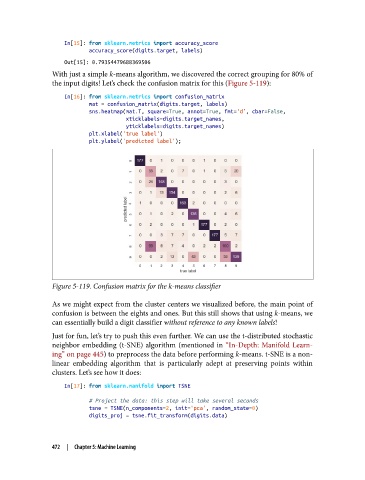
               With just a simple k-means algorithm, we discovered the correct grouping for 80% of
               the input digits! Let’s check the confusion matrix for this (Figure 5-119):

                   In[16]: from sklearn.metrics import confusion_matrix
                           mat = confusion_matrix(digits.target, labels)
                           sns.heatmap(mat.T, square=True, annot=True, fmt='d', cbar=False,
                                       xticklabels=digits.target_names,
                                       yticklabels=digits.target_names)
                           plt.xlabel('true label')
                           plt.ylabel('predicted label');


               Figure 5-119. Confusion matrix for the k-means classifier


               As we might expect from the cluster centers we visualized before, the main point of
               confusion is between the eights and ones. But this still shows that using k-means, we
               can essentially build a digit classifier without reference to any known labels!
               Just for fun, let’s try to push this even further. We can use the t-distributed stochastic
               neighbor embedding (t-SNE) algorithm (mentioned in “In-Depth: Manifold Learn‐
               ing” on page 445) to preprocess the data before performing k-means. t-SNE is a non‐
               linear embedding algorithm that is particularly adept at preserving points within
               clusters. Let’s see how it does:

                   In[17]: from sklearn.manifold import TSNE
                           # Project the data: this step will take several seconds
                           tsne = TSNE(n_components=2, init='pca', random_state=0)
                           digits_proj = tsne.fit_transform(digits.data)


               472  |  Chapter 5: Machine Learning

