


Page 485 - Python Data Science Handbook
P. 485
Caveats of expectation–maximization

               There are a few issues to be aware of when using the expectation–maximization
               algorithm.

               The globally optimal result may not be achieved
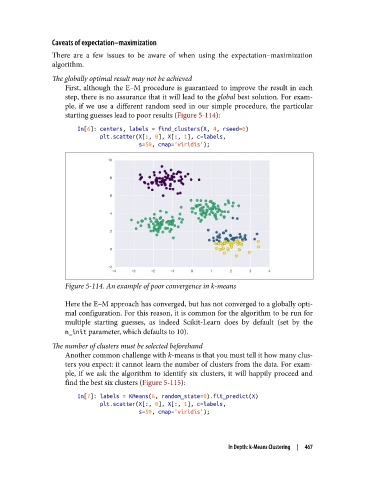
                   First, although the E–M procedure is guaranteed to improve the result in each
                   step, there is no assurance that it will lead to the global best solution. For exam‐
                   ple, if we use a different random seed in our simple procedure, the particular
                   starting guesses lead to poor results (Figure 5-114):

                      In[6]: centers, labels = find_clusters(X, 4, rseed=0)
                             plt.scatter(X[:, 0], X[:, 1], c=labels,
                                         s=50, cmap='viridis');


                   Figure 5-114. An example of poor convergence in k-means


                   Here the E–M approach has converged, but has not converged to a globally opti‐
                   mal configuration. For this reason, it is common for the algorithm to be run for
                   multiple starting guesses, as indeed Scikit-Learn does by default (set by the
                   n_init parameter, which defaults to 10).

               The number of clusters must be selected beforehand
                   Another common challenge with k-means is that you must tell it how many clus‐
                   ters you expect: it cannot learn the number of clusters from the data. For exam‐
                   ple, if we ask the algorithm to identify six clusters, it will happily proceed and
                   find the best six clusters (Figure 5-115):

                      In[7]: labels = KMeans(6, random_state=0).fit_predict(X)
                             plt.scatter(X[:, 0], X[:, 1], c=labels,
                                         s=50, cmap='viridis');


                                                                In Depth: k-Means Clustering  |  467

