


Page 489 - Python Data Science Handbook
P. 489
In[11]: from sklearn.datasets import load_digits
                           digits = load_digits()
                           digits.data.shape
                   Out[11]: (1797, 64)
               The clustering can be performed as we did before:

                   In[12]: kmeans = KMeans(n_clusters=10, random_state=0)
                           clusters = kmeans.fit_predict(digits.data)
                           kmeans.cluster_centers_.shape
                   Out[12]: (10, 64)
               The result is 10 clusters in 64 dimensions. Notice that the cluster centers themselves
               are 64-dimensional points, and can themselves be interpreted as the “typical” digit
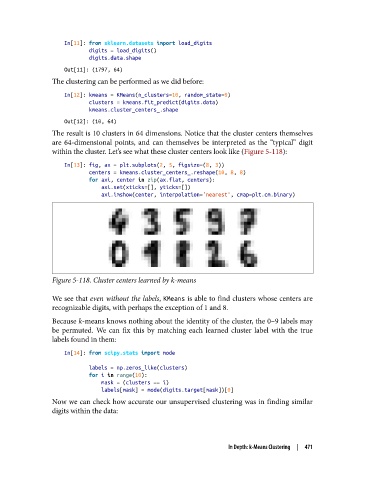
               within the cluster. Let’s see what these cluster centers look like (Figure 5-118):

                   In[13]: fig, ax = plt.subplots(2, 5, figsize=(8, 3))
                           centers = kmeans.cluster_centers_.reshape(10, 8, 8)
                           for axi, center in zip(ax.flat, centers):
                               axi.set(xticks=[], yticks=[])
                               axi.imshow(center, interpolation='nearest', cmap=plt.cm.binary)


               Figure 5-118. Cluster centers learned by k-means

               We see that even without the labels, KMeans is able to find clusters whose centers are
               recognizable digits, with perhaps the exception of 1 and 8.
               Because k-means knows nothing about the identity of the cluster, the 0–9 labels may
               be permuted. We can fix this by matching each learned cluster label with the true
               labels found in them:
                   In[14]: from scipy.stats import mode

                           labels = np.zeros_like(clusters)
                           for i in range(10):
                               mask = (clusters == i)
                               labels[mask] = mode(digits.target[mask])[0]
               Now we can check how accurate our unsupervised clustering was in finding similar
               digits within the data:


                                                                In Depth: k-Means Clustering  |  471

