


Page 484 - Python Data Science Handbook
P. 484
In[5]: from sklearn.metrics import pairwise_distances_argmin
                          def find_clusters(X, n_clusters, rseed=2):
                              # 1. Randomly choose clusters
                              rng = np.random.RandomState(rseed)
                              i = rng.permutation(X.shape[0])[:n_clusters]
                              centers = X[i]

                              while True:
                                  # 2a. Assign labels based on closest center
                                  labels = pairwise_distances_argmin(X, centers)
                                  # 2b. Find new centers from means of points
                                  new_centers = np.array([X[labels == i].mean(0)
                                                          for i in range(n_clusters)])
                                  # 2c. Check for convergence
                                  if np.all(centers == new_centers):
                                      break
                                  centers = new_centers

                              return centers, labels
                          centers, labels = find_clusters(X, 4)
                          plt.scatter(X[:, 0], X[:, 1], c=labels,
                                      s=50, cmap='viridis');


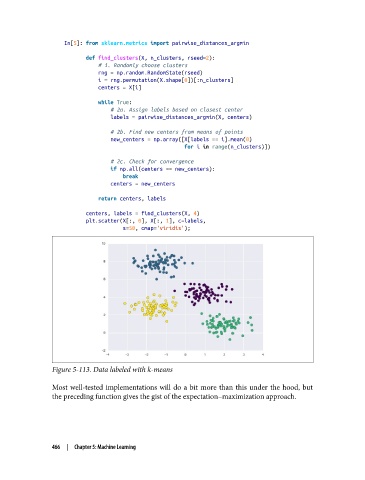
               Figure 5-113. Data labeled with k-means

               Most well-tested implementations will do a bit more than this under the hood, but
               the preceding function gives the gist of the expectation–maximization approach.


               466  |  Chapter 5: Machine Learning

