


Page 69 - Python Data Science Handbook
P. 69
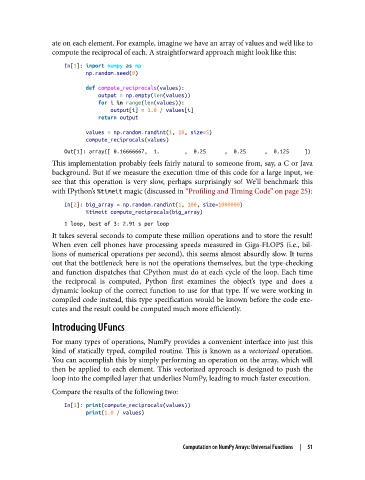
ate on each element. For example, imagine we have an array of values and we’d like to
               compute the reciprocal of each. A straightforward approach might look like this:

                   In[1]: import numpy as np
                          np.random.seed(0)

                          def compute_reciprocals(values):
                              output = np.empty(len(values))
                              for i in range(len(values)):
                                  output[i] = 1.0 / values[i]
                              return output
                          values = np.random.randint(1, 10, size=5)
                          compute_reciprocals(values)
                   Out[1]: array([ 0.16666667,  1.        ,  0.25      ,  0.25      ,  0.125     ])
               This implementation probably feels fairly natural to someone from, say, a C or Java
               background. But if we measure the execution time of this code for a large input, we
               see that this operation is very slow, perhaps surprisingly so! We’ll benchmark this
               with IPython’s %timeit magic (discussed in “Profiling and Timing Code” on page 25):

                   In[2]: big_array = np.random.randint(1, 100, size=1000000)
                          %timeit compute_reciprocals(big_array)
                   1 loop, best of 3: 2.91 s per loop
               It takes several seconds to compute these million operations and to store the result!
               When even cell phones have processing speeds measured in Giga-FLOPS (i.e., bil‐
               lions of numerical operations per second), this seems almost absurdly slow. It turns
               out that the bottleneck here is not the operations themselves, but the type-checking
               and function dispatches that CPython must do at each cycle of the loop. Each time
               the reciprocal is computed, Python first examines the object’s type and does a
               dynamic lookup of the correct function to use for that type. If we were working in
               compiled code instead, this type specification would be known before the code exe‐
               cutes and the result could be computed much more efficiently.

               Introducing UFuncs

               For many types of operations, NumPy provides a convenient interface into just this
               kind of statically typed, compiled routine. This is known as a vectorized  operation.
               You can accomplish this by simply performing an operation on the array, which will
               then be applied to each element. This vectorized approach is designed to push the
               loop into the compiled layer that underlies NumPy, leading to much faster execution.

               Compare the results of the following two:
                   In[3]: print(compute_reciprocals(values))
                          print(1.0 / values)


                                                    Computation on NumPy Arrays: Universal Functions  |  51

