


Page 71 - Python Data Science Handbook
P. 71
print("x / 2 =", x / 2)
                          print("x // 2 =", x // 2)  # floor division
                   x     = [0 1 2 3]
                   x + 5 = [5 6 7 8]
                   x - 5 = [-5 -4 -3 -2]
                   x * 2 = [0 2 4 6]
                   x / 2 = [ 0.   0.5  1.   1.5]
                   x // 2 = [0 0 1 1]

               There is also a unary ufunc for negation, a **  operator for exponentiation, and a %
               operator for modulus:
                   In[8]: print("-x     = ", -x)
                          print("x ** 2 = ", x ** 2)
                          print("x % 2  = ", x % 2)
                   -x     =  [ 0 -1 -2 -3]
                   x ** 2 =  [0 1 4 9]
                   x % 2  =  [0 1 0 1]
               In addition, these can be strung together however you wish, and the standard order
               of operations is respected:

                   In[9]: -(0.5*x + 1) ** 2
                   Out[9]: array([-1.  , -2.25, -4.  , -6.25])
               All of these arithmetic operations are simply convenient wrappers around specific
               functions built into NumPy; for example, the +  operator is a wrapper for the add
               function:

                   In[10]: np.add(x, 2)
                   Out[10]: array([2, 3, 4, 5])
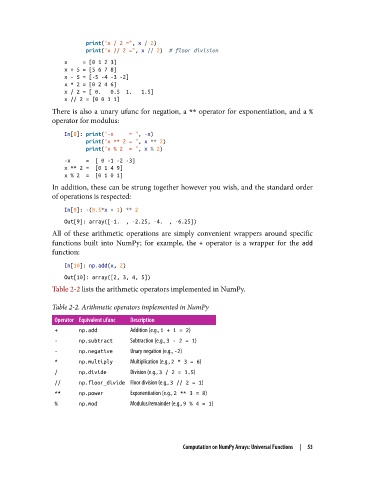
               Table 2-2 lists the arithmetic operators implemented in NumPy.

               Table 2-2. Arithmetic operators implemented in NumPy
                Operator Equivalent ufunc  Description
                +      np.add        Addition (e.g., 1 + 1 = 2)
                -      np.subtract   Subtraction (e.g., 3 - 2 = 1)
                -      np.negative   Unary negation (e.g., -2)
                *      np.multiply   Multiplication (e.g., 2 * 3 = 6)
                /      np.divide     Division (e.g., 3 / 2 = 1.5)
                //     np.floor_divide Floor division (e.g., 3 // 2 = 1)
                **     np.power      Exponentiation (e.g., 2 ** 3 = 8)
                %      np.mod        Modulus/remainder (e.g., 9 % 4 = 1)


                                                    Computation on NumPy Arrays: Universal Functions  |  53

