


Page 67 - Python Data Science Handbook
P. 67
Out[47]: array([[1, 2, 3, 1, 2, 3],
                                   [4, 5, 6, 4, 5, 6]])
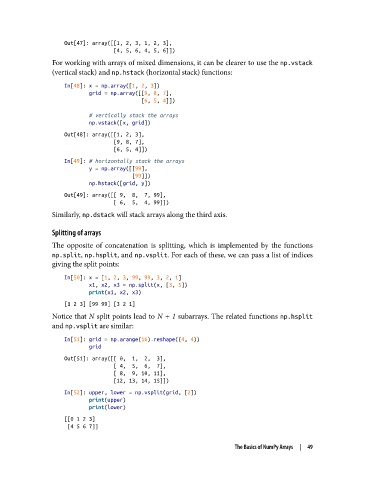
               For working with arrays of mixed dimensions, it can be clearer to use the np.vstack
               (vertical stack) and np.hstack (horizontal stack) functions:
                   In[48]: x = np.array([1, 2, 3])
                           grid = np.array([[9, 8, 7],
                                            [6, 5, 4]])
                           # vertically stack the arrays
                           np.vstack([x, grid])
                   Out[48]: array([[1, 2, 3],
                                   [9, 8, 7],
                                   [6, 5, 4]])
                   In[49]: # horizontally stack the arrays
                           y = np.array([[99],
                                         [99]])
                           np.hstack([grid, y])
                   Out[49]: array([[ 9,  8,  7, 99],
                                   [ 6,  5,  4, 99]])
               Similarly, np.dstack will stack arrays along the third axis.

               Splitting of arrays
               The opposite of concatenation is splitting, which is implemented by the functions
               np.split, np.hsplit, and np.vsplit. For each of these, we can pass a list of indices
               giving the split points:
                   In[50]: x = [1, 2, 3, 99, 99, 3, 2, 1]
                           x1, x2, x3 = np.split(x, [3, 5])
                           print(x1, x2, x3)
                   [1 2 3] [99 99] [3 2 1]
               Notice that N split points lead to N + 1 subarrays. The related functions np.hsplit
               and np.vsplit are similar:

                   In[51]: grid = np.arange(16).reshape((4, 4))
                           grid
                   Out[51]: array([[ 0,  1,  2,  3],
                                   [ 4,  5,  6,  7],
                                   [ 8,  9, 10, 11],
                                   [12, 13, 14, 15]])
                   In[52]: upper, lower = np.vsplit(grid, [2])
                           print(upper)
                           print(lower)
                   [[0 1 2 3]
                    [4 5 6 7]]

                                                                  The Basics of NumPy Arrays  |  49

