


Page 76 - Python Data Science Handbook
P. 76
In[29]: np.multiply.accumulate(x)
                   Out[29]: array([  1,   2,   6,  24, 120])
               Note that for these particular cases, there are dedicated NumPy functions to compute
               the results (np.sum, np.prod, np.cumsum, np.cumprod), which we’ll explore in “Aggre‐
               gations: Min, Max, and Everything in Between” on page 58.

               Outer products
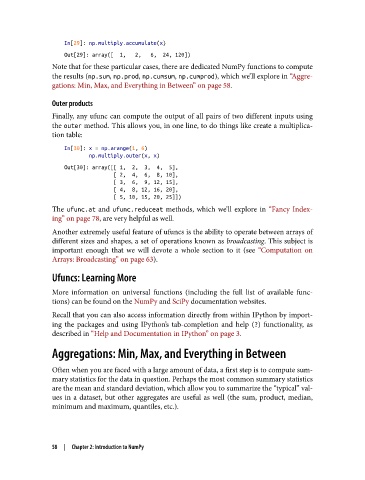
               Finally, any ufunc can compute the output of all pairs of two different inputs using
               the outer method. This allows you, in one line, to do things like create a multiplica‐
               tion table:

                   In[30]: x = np.arange(1, 6)
                           np.multiply.outer(x, x)
                   Out[30]: array([[ 1,  2,  3,  4,  5],
                                   [ 2,  4,  6,  8, 10],
                                   [ 3,  6,  9, 12, 15],
                                   [ 4,  8, 12, 16, 20],
                                   [ 5, 10, 15, 20, 25]])
               The ufunc.at  and ufunc.reduceat  methods, which we’ll explore in “Fancy Index‐
               ing” on page 78, are very helpful as well.
               Another extremely useful feature of ufuncs is the ability to operate between arrays of
               different sizes and shapes, a set of operations known as broadcasting. This subject is
               important enough that we will devote a whole section to it (see “Computation on
               Arrays: Broadcasting” on page 63).

               Ufuncs: Learning More

               More information on universal functions (including the full list of available func‐
               tions) can be found on the NumPy and SciPy documentation websites.
               Recall that you can also access information directly from within IPython by import‐
               ing the packages and using IPython’s tab-completion and help (?) functionality, as
               described in “Help and Documentation in IPython” on page 3.
               Aggregations: Min, Max, and Everything in Between


               Often when you are faced with a large amount of data, a first step is to compute sum‐
               mary statistics for the data in question. Perhaps the most common summary statistics
               are the mean and standard deviation, which allow you to summarize the “typical” val‐
               ues in a dataset, but other aggregates are useful as well (the sum, product, median,
               minimum and maximum, quantiles, etc.).


               58  |  Chapter 2: Introduction to NumPy

