


Page 81 - Python Data Science Handbook
P. 81
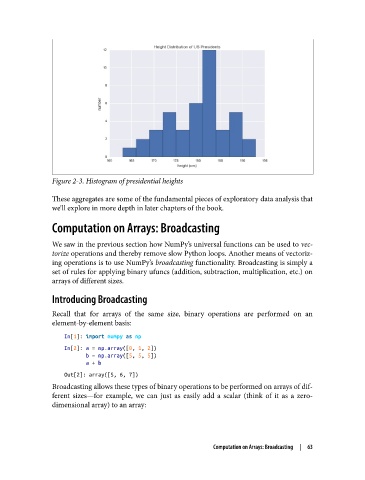
Figure 2-3. Histogram of presidential heights

               These aggregates are some of the fundamental pieces of exploratory data analysis that
               we’ll explore in more depth in later chapters of the book.

               Computation on Arrays: Broadcasting

               We saw in the previous section how NumPy’s universal functions can be used to vec‐
               torize operations and thereby remove slow Python loops. Another means of vectoriz‐
               ing operations is to use NumPy’s broadcasting functionality. Broadcasting is simply a
               set of rules for applying binary ufuncs (addition, subtraction, multiplication, etc.) on
               arrays of different sizes.
               Introducing Broadcasting

               Recall that for arrays of the same size, binary operations are performed on an
               element-by-element basis:
                   In[1]: import numpy as np
                   In[2]: a = np.array([0, 1, 2])
                          b = np.array([5, 5, 5])
                          a + b
                   Out[2]: array([5, 6, 7])
               Broadcasting allows these types of binary operations to be performed on arrays of dif‐
               ferent sizes—for example, we can just as easily add a scalar (think of it as a zero-
               dimensional array) to an array:


                                                            Computation on Arrays: Broadcasting  |  63

