


Page 83 - Python Data Science Handbook
P. 83
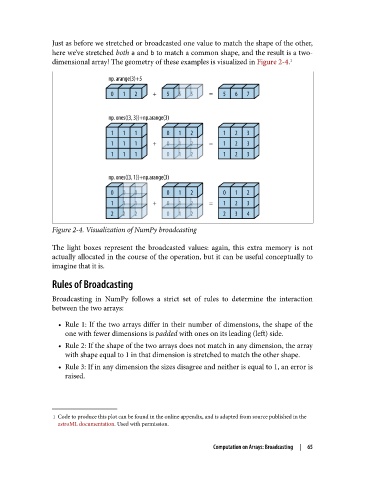
Just as before we stretched or broadcasted one value to match the shape of the other,
               here we’ve stretched both a and b to match a common shape, and the result is a two-
               dimensional array! The geometry of these examples is visualized in Figure 2-4. 1


               Figure 2-4. Visualization of NumPy broadcasting

               The light boxes represent the broadcasted values: again, this extra memory is not
               actually allocated in the course of the operation, but it can be useful conceptually to
               imagine that it is.

               Rules of Broadcasting

               Broadcasting in NumPy follows a strict set of rules to determine the interaction
               between the two arrays:

                 • Rule 1: If the two arrays differ in their number of dimensions, the shape of the
                   one with fewer dimensions is padded with ones on its leading (left) side.
                 • Rule 2: If the shape of the two arrays does not match in any dimension, the array
                   with shape equal to 1 in that dimension is stretched to match the other shape.
                 • Rule 3: If in any dimension the sizes disagree and neither is equal to 1, an error is
                   raised.


                1 Code to produce this plot can be found in the online appendix, and is adapted from source published in the
                 astroML documentation. Used with permission.


                                                            Computation on Arrays: Broadcasting  |  65

