


Page 82 - Python Data Science Handbook
P. 82
In[3]: a + 5
                   Out[3]: array([5, 6, 7])
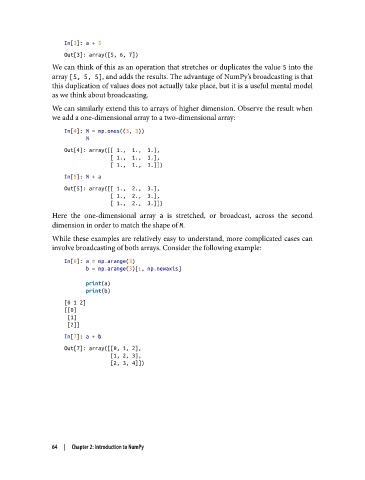
               We can think of this as an operation that stretches or duplicates the value 5 into the
               array [5, 5, 5], and adds the results. The advantage of NumPy’s broadcasting is that
               this duplication of values does not actually take place, but it is a useful mental model
               as we think about broadcasting.
               We can similarly extend this to arrays of higher dimension. Observe the result when
               we add a one-dimensional array to a two-dimensional array:

                   In[4]: M = np.ones((3, 3))
                          M
                   Out[4]: array([[ 1.,  1.,  1.],
                                  [ 1.,  1.,  1.],
                                  [ 1.,  1.,  1.]])
                   In[5]: M + a
                   Out[5]: array([[ 1.,  2.,  3.],
                                  [ 1.,  2.,  3.],
                                  [ 1.,  2.,  3.]])
               Here the one-dimensional array a  is stretched, or broadcast, across the second
               dimension in order to match the shape of M.
               While these examples are relatively easy to understand, more complicated cases can
               involve broadcasting of both arrays. Consider the following example:
                   In[6]: a = np.arange(3)
                          b = np.arange(3)[:, np.newaxis]
                          print(a)
                          print(b)
                   [0 1 2]
                   [[0]
                    [1]
                    [2]]
                   In[7]: a + b
                   Out[7]: array([[0, 1, 2],
                                  [1, 2, 3],
                                  [2, 3, 4]])


               64  |  Chapter 2: Introduction to NumPy

