


Page 79 - Python Data Science Handbook
P. 79
first axis will be collapsed: for two-dimensional arrays, this means that values within
               each column will be aggregated.

               Other aggregation functions
               NumPy provides many other aggregation functions, but we won’t discuss them in
               detail here. Additionally, most aggregates have a NaN-safe counterpart that computes
               the result while ignoring missing values, which are marked by the special IEEE
               floating-point NaN value (for a fuller discussion of missing data, see “Handling Miss‐
               ing Data” on page 119). Some of these NaN-safe functions were not added until
               NumPy 1.8, so they will not be available in older NumPy versions.
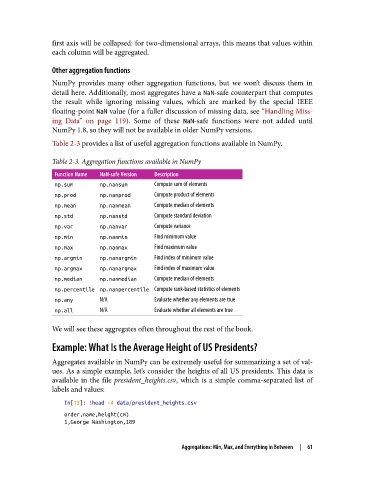
               Table 2-3 provides a list of useful aggregation functions available in NumPy.

               Table 2-3. Aggregation functions available in NumPy
                Function Name  NaN-safe Version  Description
                np.sum       np.nansum      Compute sum of elements
                np.prod      np.nanprod     Compute product of elements
                np.mean      np.nanmean     Compute median of elements
                np.std       np.nanstd      Compute standard deviation
                np.var       np.nanvar      Compute variance
                np.min       np.nanmin      Find minimum value
                np.max       np.nanmax      Find maximum value
                np.argmin    np.nanargmin   Find index of minimum value
                np.argmax    np.nanargmax   Find index of maximum value
                np.median    np.nanmedian   Compute median of elements
                np.percentile np.nanpercentile Compute rank-based statistics of elements
                np.any       N/A            Evaluate whether any elements are true
                np.all       N/A            Evaluate whether all elements are true

               We will see these aggregates often throughout the rest of the book.

               Example: What Is the Average Height of US Presidents?

               Aggregates available in NumPy can be extremely useful for summarizing a set of val‐
               ues. As a simple example, let’s consider the heights of all US presidents. This data is
               available in the file president_heights.csv, which is a simple comma-separated list of
               labels and values:

                   In[13]: !head -4 data/president_heights.csv
                   order,name,height(cm)
                   1,George Washington,189


                                                   Aggregations: Min, Max, and Everything in Between  |  61

