


Page 111 - Template Tesis UTM v2.0
P. 111
This was done to suit the types of reinforcement and resin used. Prior to the test, all

                   the specimens were inspected to ensure all the cutting edges are in good conditions.
                   During  the  testing,  specimens  were  aligned  as  perfectly  as  possible  using  the

                   recommended grip face, according to the sample thickness with the direction of the
                   pull. They were also tightened firmly to minimise the rotary motion that could induce

                   slippage. The gauge length was kept at 100 mm for all the specimens and for each of
                   the sample configuration, five measurements were tested to obtain an average result.


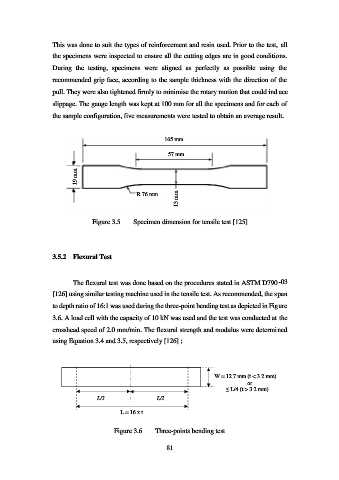
                                                           165 mm

                                                            57 mm


                            19 mm


                                                               13 mm
                                                 R 76 mm


                                 Figure 3.5     Specimen dimension for tensile test [125]


                   3.5.2  Flexural Test


                           The flexural test was done based on the procedures stated in ASTM D790-03

                   [126] using similar testing machine used in the tensile test. As recommended, the span
                   to depth ratio of 16:1 was used during the three-point bending test as depicted in Figure

                   3.6. A load cell with the capacity of 10 kN was used and the test was conducted at the
                   crosshead speed of 2.0 mm/min. The flexural strength and modulus were determined

                   using Equation 3.4 and 3.5, respectively [126] ;


                                                                            W = 12.7 mm (t < 3.2 mm)
                                                                                                   or
                                                                                    ≤ L/4 (t > 3.2 mm)
                                   L/2                  L/2

                                           L = 16 x t


                                         Figure 3.6    Three-points bending test

                                                           81

