


Page 114 - Template Tesis UTM v2.0
P. 114
3.5.4  Low Velocity Impact Test


                           Most of the composite structures and parts used in advanced applications are

                   fibre reinforced composites that should have a service life of 25 to 30 years which

                   might  be  subjected to  various loading conditions. Therefore, its  responses  to  such
                   conditions should be clearly understood. Several approaches have been exploited to

                   enhance the impact damage resistance of composite laminates. The flying fragment or

                   a drop of tool with low velocity can impact the composite structure, which will cause
                   damage such as delamination, fibre breakage and matrix failure if the impact energy

                   is high enough [68]. Many factors affect the impact response and the critical factors
                   include  laminate  thickness,  lay-up  configuration,  impactor  size,  impactor  shape,

                   constituent properties, temperature, impact velocity and energy [132]. Moreover, there
                   are three distinct interaction modes between laminates and impactor, which are, the

                   impactor  will bounce back if the composite absorbed small energy, no rebound will

                   occur if most of the impactor’s energy was absorbed by the composite through various
                   modes of damages such as delamination and matrix cracking, and perforation can be

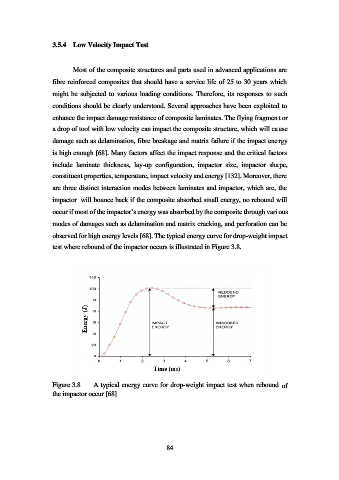
                   observed for high energy levels [68]. The typical energy curve for drop-weight impact
                   test where rebound of the impactor occurs is illustrated in Figure 3.8.


                   Figure 3.8     A typical energy curve for drop-weight impact test when rebound of
                   the impactor occur [68]


                                                           84

