


Page 35 - Spotlight A+ Form 4 & 5 Chemistry KSSM
P. 35
Form
5 Chemistry Chapter 1 Redox Equilibrium
CHAP. Daniell Cell CHAP.
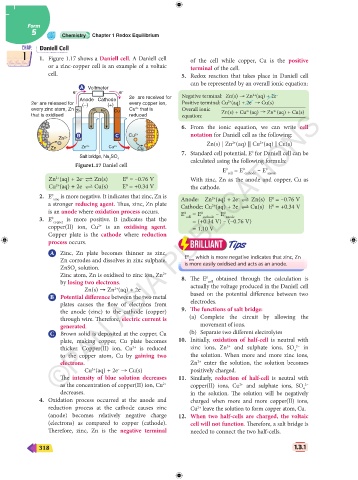
1 1. Figure 1.17 shows a Daniell cell. A Daniell cell of the cell while copper, Cu is the positive 1
or a zinc-copper cell is an example of a voltaic terminal of the cell.
cell. 5. Redox reaction that takes place in Daniell cell
can be represented by an overall ionic equation:
A Voltmeter
e – e – 2+ –
2e are received for Negative terminal: Zn(s) → Zn (aq) + 2e
–
Anode Cathode
2+
–
–
2e are released for (–) (+) every copper ion, Positive terminal: Cu (aq) + 2e → Cu(s)
2+
every zinc atom, Zn – Cu that is Overall ionic
2+
2+
Zn SO 4 Na + Cu Zn(s) + Cu (aq) → Zn (aq) + Cu(s)
©PAN ASIA PUBLICATIONS
that is oxidised reduced equation:
6. From the ionic equation, we can write cell
e – B C Cu 2+ notation for Daniell cell as the following:
Zn 2+
2+
2+
e – e – Zn(s) | Zn (aq) || Cu (aq) | Cu(s)
Zn Zn 2+ Cu 2+ Cu
7. Standard cell potential, E for Daniell cell can be
0
Salt bridge, Na SO
2 4 calculated using the following formula:
Figure1.17 Daniel cell
E 0 cell = E 0 cathode – E 0 anode
Zn (aq) + 2e Zn(s) E = –0.76 V With zinc, Zn as the anode and copper, Cu as
–
0
2+
Cu (aq) + 2e Cu(s) E = +0.34 V the cathode.
0
–
2+
2. E 0 zinc is more negative. It indicates that zinc, Zn is Anode: Zn (aq) + 2e Zn(s) E = –0.76 V
0
–
2+
a stronger reducing agent. Thus, zinc, Zn plate Cathode: Cu (aq) + 2e Cu(s) E = +0.34 V
0
–
2+
is an anode where oxidation process occurs. E 0 = E 0 – E 0
cathode
anode
3. E 0 copper is more positive. It indicates that the cell = (+0.34 V) – (–0.76 V)
copper(II) ion, Cu is an oxidising agent. = 1.10 V
2+
Copper plate is the cathode where reduction
process occurs.
A Zinc, Zn plate becomes thinner as zinc, 0
which is more negative indicates that zinc, Zn
Zn corrodes and dissolves in zinc sulphate, E is more easily oxidised and acts as an anode.
zinc
ZnSO solution.
4
Zinc atom, Zn is oxidised to zinc ion, Zn 8. The E 0 obtained through the calculation is
2+
by losing two electrons. actually the voltage produced in the Daniell cell
cell
Zn(s) → Zn (aq) + 2e –
2+
B Potential difference between the two metal based on the potential difference between two
plates causes the flow of electrons from electrodes.
the anode (zinc) to the cathode (copper) 9. The functions of salt bridge:
through wire. Therefore, electric current is (a) Complete the circuit by allowing the
generated. movement of ions.
C Brown solid is deposited at the copper, Cu (b) Separate two different electrolytes
plate, making copper, Cu plate becomes 10. Initially, oxidation of half-cell is neutral with
2+
2−
thicker. Copper(II) ion, Cu is reduced zinc ions, Zn and sulphate ions, SO in
2+
4
to the copper atom, Cu by gaining two the solution. When more and more zinc ions,
electrons. Zn enter the solution, the solution becomes
2+
Cu (aq) + 2e → Cu(s) positively charged.
2+
‒
The intensity of blue solution decreases 11. Similarly, reduction of half-cell is neutral with
as the concentration of copper(II) ion, Cu copper(II) ions, Cu and sulphate ions, SO
2+
2−
2+
4
decreases. in the solution. The solution will be negatively
4. Oxidation process occurred at the anode and charged when more and more copper(II) ions,
reduction process at the cathode causes zinc Cu leave the solution to form copper atom, Cu.
2+
(anode) becomes relatively negative charge 12. When two half-cells are charged, the voltaic
(electrons) as compared to copper (cathode). cell will not function. Therefore, a salt bridge is
Therefore, zinc, Zn is the negative terminal needed to connect the two half-cells.
318 1.3.1

