


Page 34 - Spotlight A+ Form 4 & 5 Chemistry KSSM
P. 34
Form
                                                                                                           5
                                                                   Chapter 1 Redox Equilibrium  Chemistry
 CHAP.                                                                                                       CHAP.
                                                                                      +
 1                  4.  The voltmeter reading is recorded. All        (e)  Hydrogen ions, H  are reduced to form   1
                      observations at the electrodes are recorded.
                                                                      hydrogen gas, H  by  gaining  electrons.
                                                                                     2
                    5.  Steps 1 to 4 are repeated using zinc, Zn plate   Reduction occurs at the copper, Cu plate.
                                                                                    +
                      and copper, Cu plate.                           Hydrogen ion, H  acts as oxidising agent.
                                                                     (f)  Electrons move from iron, Fe nail to copper,
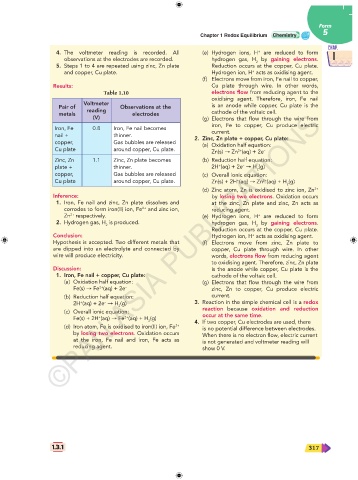
                  Results:                                            Cu plate through wire. In other words,
                                   Table 1.10                         electrons flow from reducing agent to the
                                                                      oxidising  agent.  Therefore,  iron,  Fe  nail
                            Voltmeter
                    Pair of             Observations at the           is an  anode while  copper,  Cu plate  is the
                             reading                                  cathode of the voltaic cell.
                    metals                  electrodes
                    ©PAN ASIA PUBLICATIONS
                                (V)                                  (g)  Electrons  that  flow  through  the  wire  from
                   Iron, Fe    0.8    Iron, Fe nail becomes           iron, Fe to copper, Cu produce electric
                   nail +             thinner.                        current.
                                                                  2.  Zinc, Zn plate + copper, Cu plate:
                   copper,            Gas bubbles are released        (a)  Oxidation half equation:
                   Cu plate           around copper, Cu plate.                 2+       –
                                                                       Zn(s) → Zn (aq) + 2e
                   Zinc, Zn    1.1    Zinc, Zn plate becomes         (b)  Reduction half equation:
                                                                                 –
                                                                         +
                   plate +            thinner.                         2H (aq) + 2e  → H (g)
                                                                                     2
                   copper,            Gas bubbles are released        (c)  Overall ionic equation:
                   Cu plate           around copper, Cu plate.          Zn(s) + 2H (aq) → Zn (aq) + H (g)
                                                                               +
                                                                                       2+
                                                                                               2
                                                                     (d)  Zinc atom, Zn is oxidised to zinc ion, Zn
                                                                                                        2+
                  Inference:                                          by losing two electrons. Oxidation occurs
                    1.  Iron, Fe nail and zinc, Zn plate dissolves and   at  the  zinc,  Zn  plate  and  zinc,  Zn  acts  as
                      corrodes to form iron(II) ion, Fe  and zinc ion,   reducing agent.
                                                2+
                        2+
                      Zn  respectively.                              (e)  Hydrogen ions, H  are reduced to form
                                                                                      +
                    2.  Hydrogen gas, H  is produced.                 hydrogen gas, H  by  gaining  electrons.
                                    2                                                2
                                                                      Reduction occurs at the copper, Cu plate.
                                                                                    +
                  Conclusion:                                         Hydrogen ion, H  acts as oxidising agent.
                  Hypothesis is accepted. Two different metals that        (f)  Electrons move  from zinc, Zn plate  to
                  are dipped into an electrolyte and connected by     copper, Cu plate through wire. In other
                  wire will produce electricity.                      words, electrons flow from reducing agent
                                                                      to oxidising agent. Therefore, zinc, Zn plate
                  Discussion:                                         is the anode while copper, Cu plate is the
                    1.  Iron, Fe nail + copper, Cu plate:             cathode of the voltaic cell.
                       (a)  Oxidation half equation:                 (g)  Electrons  that  flow  through  the  wire  from
                         Fe(s) → Fe (aq) + 2e –                       zinc, Zn to  copper, Cu produce  electric
                                  2+
                       (b)  Reduction half equation:                  current.
                                   –
                           +
                         2H (aq) + 2e  → H (g)                    3.  Reaction in the simple chemical cell is a redox
                                        2
                       (c)  Overall ionic equation:                reaction because  oxidation and reduction
                                          2+
                                 +
                          Fe(s) + 2H (aq) → Fe (aq) + H (g)        occur at the same time.
                                                  2               4.  If two copper, Cu electrodes are used, there
                       (d)  Iron atom, Fe is oxidised to iron(II) ion, Fe    is no potential difference between electrodes.
                                                           2+
                         by losing two electrons. Oxidation occurs   When there is no electron flow, electric current
                         at the iron, Fe nail and iron, Fe acts as   is not generated and voltmeter reading will
                         reducing agent.
                                                                   show 0 V.


                  1.3.1                                                                               317

