


Page 33 - Spotlight A+ Form 4 & 5 Chemistry KSSM
P. 33
Form
           5          Chemistry   Chapter 1 Redox Equilibrium

        CHAP.    5.  Redox reaction occurred in the simple chemical     7.  The  relative charge on the electrode depends                                                                                                CHAP.
         1       cell can be represented by the following overall   on the source of electrons and the direction of                                                                                                       1
                 ionic equation:                               flow of electrons.
                                                               (a)  Since  the electrons released by the
              Oxidation half equation:  Mg(s) → Mg (aq) + 2e –     magnesium   atom,   Mg   enters  the
                                           2+
              Reduction half equation:  2H (aq) + 2e  → H (g)      magnesium, Mg electrode while  the
                                          –
                                   +
                                              2                    electrons that reach the copper, Cu
              Overall ionic equation:   Mg(s) + 2H (aq) → Mg (aq) + H (g)  electrode are given to the hydrogen ion,
                                         +
                                                  2+
                                                        2
                                                                   H , magnesium, Mg electrode relatively
                                                                     +
               6.  The area where oxidation occurs is called anode   contains more negative charge (electrons)
                    ©PAN ASIA PUBLICATIONS
                 and the area where  reduction occurs is  called   compare to copper, Cu electrode.
                 cathode.  Thus,  the magnesium, Mg  electrode   (b)  Thus, magnesium, Mg electrode is the
                 acts as an anode while the copper, Cu electrode   negative terminal of the cell and the
                 acts as a cathode in this simple chemical cell.   copper, Cu electrode is the  positive
                                                                   terminal of the cell.
                   U seful Acronym                             (c)  The   potential  difference  between
                                                                   magnesium, Mg and copper, Cu causes the
                                                                   transfer  of  electrons through  the  external
                                                                   circuit and an electric current is produced.
                                                               (d)  Hydrogen gas, H  on the copper, Cu surface
                                                                                 2
                                                                   results in  polarisation and  prevents
                                                                   further reduction of hydrogen ions,
                                                                     +
                       Red cat             An ox                   H . Hence, simple chemical cell can  only
                  Reduction; cathode   Oxidation; anode            function for a short period of time.
                                                             8.  This  problem was solved by John Frederic
                                                               Daniell, a British chemist in 1836 who invented
                                                               Daniell cell.


                                      1.1

              Aim:                                          Procedure:
              To show the production of electricity through redox     1.  A copper, Cu plate and iron, Fe nail are cleaned
              reaction in a simple voltaic cell.               with sandpaper.
                                                                     3
                                                                                 -3
              Problem statement:                              2.  150 cm  of 1.0 mol dm  sulphuric acid, H SO  is
                                                                                                2
                                                                                                   4
              How can a simple voltaic cell produce electricity   poured into a beaker.
              through redox reaction?
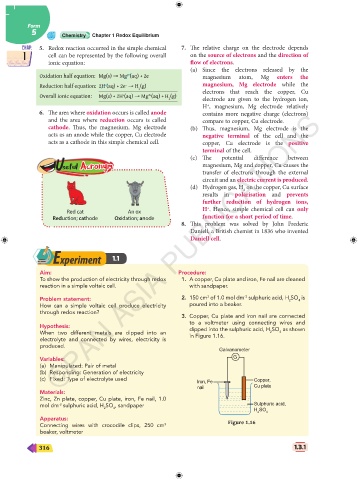
                                                              3.  Copper, Cu plate and iron nail are connected
                                                               to a voltmeter using connecting wires and
              Hypothesis:                                      dipped into the sulphuric acid, H SO  as shown
              When two different metals are dipped into an     in Figure 1.16.            2  4
              electrolyte and connected by wires, electricity is
              produced.
                                                                         Galvanometer
                                                                              G
              Variables:
              (a)  Manipulated: Pair of metal
              (b)  Responding: Generation of electricity
              (c)  Fixed: Type of electrolyte used                Iron, Fe          Copper,
                                                                  nail              Cu plate
              Materials:
              Zinc, Zn plate, copper, Cu plate, iron, Fe nail, 1.0
                    -3
              mol dm  sulphuric acid, H SO , sandpaper                              Sulphuric acid,
                                   2  4                                             H SO 4
                                                                                     2
              Apparatus:                                                    Figure 1.16
                                                       3
              Connecting wires with crocodile clips, 250 cm
              beaker, voltmeter
              316                                                                                 1.3.1

