


Page 410 - Math Smart - 7
P. 410
17.2.4 Frequency diagrams for

                                              grouped discrete data


                                     This frequency table shows grouped discrete data. The table shows the number of
                                      units in an apartment block and the number of such apartment blocks in a town.

                                      Number of units In an
                                                              0-50    51-100   51-100   51-100   51-100
                                      apartment block
                                      Frequency                32       243      521      206      96

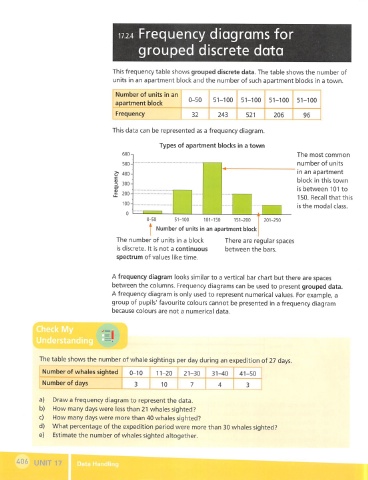
                                     This data can be represented as a frequency diagram.

                                                     Types of apartment blocks In a town
                                                                                                 The most common
                                                                                                 number of units
                                                                                                 in an apartment
                                                                                                 block in this town
                                                                                                 is between 101 to
                                     i 200-
                                                                                                 150. Recall that this
                                                                                                 is the modal class.
                                                0-50     51-100    101-150   151-200   201-250
                                                 I Number of units in an apartment block

                                       The number of units in a block     There are regular spaces
                                       is discrete. It is not a continuous  between the bars.
                                       spectrum of values like time.

                                     A frequency diagram looks similar to a vertical bar chart but there are spaces
                                     between the columns. Frequency diagrams can be used to present grouped data.
                                     A frequency diagram is only used to represent numerical values. For example, a
                                     group of pupils' favourite colours cannot be presented in a frequency diagram
                                     because colours are not a numerical data.

             Check My

             Unde

              The table shows the number of whale sightings per day during an expedition of 27 days.

               Number of whales sighted    0-10     11-20   21-30    31-40    41-50
               Number of days               3        10       7        4         3


              a)  Draw a frequency diagram to represent the data.
              b) How many days were less than 21 whales sighted?
              c)  How many days were more than 40 whales sighted?
              d) What percentage of the expedition period were more than 30 whales sighted?
              e)  Estimate the number of whales sighted altogether.


      406 UNIT 17

