


Page 107 - JURNAL PENYELIDIKAN AKADEMIK
P. 107
J u r n a l   P e n y e l i d i k a n   A k a d e m i k   I P G M   J i l i d   5 / 2 0 2 0  | 100


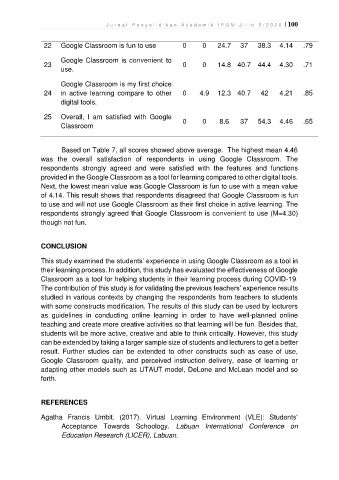
                22    Google Classroom is fun to use             0      0    24.7    37     38.3  4.14      .79

                      Google  Classroom  is convenient  to
                23                                               0      0    14.8  40.7  44.4  4.30         .71
                      use.


                      Google Classroom is my first choice
                24    in  active  learning  compare  to  other   0     4.9  12.3  40.7       42    4.21     .85
                      digital tools.

                25    Overall,  I  am  satisfied  with  Google   0      0     8.6    37     54.3  4.46      .65
                      Classroom


                       Based on Table 7, all scores showed above average.  The highest mean 4.46
               was  the  overall  satisfaction  of  respondents  in  using  Google  Classroom.  The
               respondents  strongly  agreed  and  were  satisfied  with  the  features  and  functions
               provided in the Google Classroom as a tool for learning compared to other digital tools.
               Next, the lowest mean value was Google Classroom is fun to use with a mean value
               of 4.14. This result shows that respondents disagreed that Google Classroom is fun
               to use and will not use Google Classroom as their first choice in active learning. The
               respondents strongly agreed that Google Classroom is convenient to use (M=4.30)
               though not fun.


               CONCLUSION

               This study examined the students’ experience in using Google Classroom as a tool in
               their learning process. In addition, this study has evaluated the effectiveness of Google
               Classroom as a tool for helping students in their learning process during COVID-19.
               The contribution of this study is for validating the previous teachers’ experience results
               studied in various contexts by changing the respondents from teachers to students
               with some constructs modification. The results of this study can be used by lecturers
               as  guidelines  in  conducting  online  learning  in  order  to  have  well-planned  online
               teaching and create more creative activities so that learning will be fun. Besides that,
               students will be more active, creative and able to think critically. However, this study
               can be extended by taking a larger sample size of students and lecturers to get a better
               result.  Further  studies  can  be  extended  to  other  constructs  such  as  ease  of  use,
               Google  Classroom  quality,  and  perceived  instruction  delivery,  ease  of  learning  or
               adapting other models such as UTAUT model, DeLone and McLean model and so
               forth.


               REFERENCES


               Agatha  Francis  Umbit.  (2017).  Virtual  Learning  Environment  (VLE):  Students'
                       Acceptance  Towards  Schoology.  Labuan  International  Conference  on
                       Education Research (LICER), Labuan.

