


Page 411 - Hall et al (2015) Principles of Critical Care-McGraw-Hill
P. 411
CHAPTER 36: Cardiac Arrhythmias, Pacing, Cardioversion, and Defibrillation in the Critical Care Setting  281


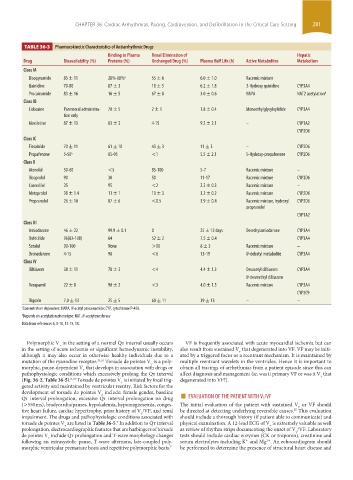
                      TABLE 36-3    Pharmacokinetic Characteristics of Antiarrhythmic Drugs
                                                 Binding to Plasma   Renal Elimination of                         Hepatic
                    Drug          Bioavailability (%)  Proteins (%)  Unchanged Drug (%)  Plasma Half Life (h)  Active Metabolites  Metabolism
                    Class IA
                      Disopyramide  83 ± 11      28%-68% a      55 ± 6           6.0 ± 1.0      Racemic mixture
                      Quinidine   70-80          87 ± 3         18 ± 5           6.2 ± 1.8      3-Hydroxy quinidine  CYP3A4
                      Procainamide  83 ± 16      16 ± 5         67 ± 8           3.0 ± 0.6      NAPA              NAT2 acetylation b
                    Class IB
                      Lidocaine   Parenteral administra-  70 ± 5  2 ± 1          1.8 ± 0.4      Monoethylglycylxylidide  CYP3A4
                                  tion only
                      Mexiletine  87 ± 13        63 ± 3         4-15             9.2 ± 2.1      –                 CYP1A2
                                                                                                                  CYP2D6
                    Class IC
                      Flecainide  70 ± 11        61 ± 10        43 ± 3           11 ± 3         –                 CYP2D6
                      Propafenone  5-50 a        85-95          <1               5.5 ± 2.1      5-Hydroxy-propafenone  CYP2D6
                    Class II
                      Atenolol    50-60          <5             85-100           5-7            Racemic mixture   –
                      Bisoprolol  90             30             50               11-17          Racemic mixture   CYP2D6
                      Carvedilol  25             95             <2               2.2 ± 0.3      Racemic mixture   –
                      Metoprolol  38 ± 1.4       11 ± 1         10 ± 3           3.2 ± 0.2      Racemic mixture   CYP2D6
                      Propranolol  26 ± 10       87 ± 6         <0.5             3.9 ± 0.4      Racemic mixture, hydroxyl   CYP2D6
                                                                                                propranolol
                                                                                                                  CYP1A2
                    Class III
                      Amiodarone  46 ± 22        99.9 ± 0.1     0                25 ± 12 days   Desethylamiodarone  CYP3A4
                      Dofetilide  96(83-108)     64             52 ± 2           7.5 ± 0.4                        CYP3A4
                      Sotalol     90-100         None           >90              8 ± 3          Racemic mixture   –
                      Dronedarone  4-15          98             <6               13-19          N-debutyl metabolite  CYP3A4
                    Class IV
                      Diltiazem   38 ± 11        78 ± 3         <4               4.4 ± 1.3      Desacetyl diltiazem  CYP3A4
                                                                                                N-desmethyl diltiazem
                      Verapamil   22 ± 8         90 ± 2         <3               4.0 ± 1.5      Racemic mixture   CYP3A4
                                                                                                                  CYP2C9
                      Digoxin     7.0 ± 13       25 ± 5         60 ± 11          39 ± 13        –                 –
                    a Concentration dependent: NAPA, N-acetyl procainamide; CYP, cytochrome P-450.
                    b Depends on acetylation phenotype: NAT, N-acetyltransferase
                    Data from references 6, 8-10, 12-15, 18.


                     Polymorphic V  in the setting of a normal Q ˙ t interval usually occurs   VF is frequently associated with acute myocardial ischemia but can
                                t
                    in the setting of acute ischemia or significant hemodynamic instability,   also result from sustained V  that degenerated into VF. VF may be initi-
                                                                                              t
                    although  it may  also occur in otherwise healthy  individuals due  to a   ated by a triggered focus or a reentrant mechanism. It is maintained by
                    mutation of the ryanodine receptor. 23,24  Torsade de pointes V  is a poly-  multiple reentrant wavelets in the ventricles. Hence it is important to
                                                                t
                    morphic, pause-dependent V  that develops in association with drugs or   obtain all tracings of arrhythmias from a patient episode since this can
                                         t
                    pathophysiologic conditions which excessively prolong the Q ˙ t interval   affect diagnosis and management (ie, was it primary VF or was it V  that
                                                                                                                         t
                    (Fig. 36-2, Table 36-5).  Torsade de pointes V  is initiated by focal trig-  degenerated into VF?).
                                    8,10
                                                     t
                    gered activity and maintained by ventricular reentry. Risk factors for the
                    Q ˙ t  interval  prolongation,  excessive  Q ˙ t  interval  prolongation on  drug   ■  EVALUATION OF THE PATIENT WITH V T /VF
                    development of torsade de pointes V  include: female gender, baseline
                                               t
                    (>550 ms), bradycardia/pauses, hypokalemia, hypomagnesemia, conges-  The  initial  evaluation  of  the  patient  with  sustained  V   or  VF  should
                                                                                                                  t
                    tive heart failure, cardiac hypertrophy, prior history of V /VF, and renal   be directed at detecting underlying reversible causes.  This evaluation
                                                                                                                25
                                                            t
                    impairment. The drugs and pathophysiologic conditions associated with   should include a thorough history (if patient able to communicate) and
                    torsade de pointes V  are listed in Table 36-5.  In addition to Q ˙ t interval   physical examination. A 12-lead ECG of V  is extremely valuable as well
                                                    7
                                                                                                        t
                                  t
                    prolongation, electrocardiographic features that are harbingers of torsade   as review of rhythm strips documenting the onset of V /VF. Laboratory
                                                                                                                 t
                    de pointes V  include Q ˙ t prolongation and T-wave morphology changes   tests should include cardiac enzymes (CK or troponin), creatinine and
                             t
                    following an extrasystolic pause, T-wave alternans, late-coupled poly-  serum electrolytes including K  and Mg . An echocardiogram should
                                                                                                +
                                                                                                       2+
                    morphic ventricular premature beats and repetitive polymorphic beats. 7  be performed to determine the presence of structural heart disease and
            section03.indd   281                                                                                       1/23/2015   2:07:09 PM

