


Page 388 - Clinical Application of Mechanical Ventilation
P. 388
354    Chapter 11


                                            from auto-PEEP, which will be readily apparent when graphics are available. A patient
                                            may have to be sedated and paralyzed temporarily to be mechanically controlled at low
                                            frequencies (6 to 8/min) and low V  (e.g., 4 to 7 mL/kg IBW) to prevent severe auto-
                                                                         T
                                            PEEP and lung damage (ARDSNet, 2000).
                                            Loss of Elastic Recoil


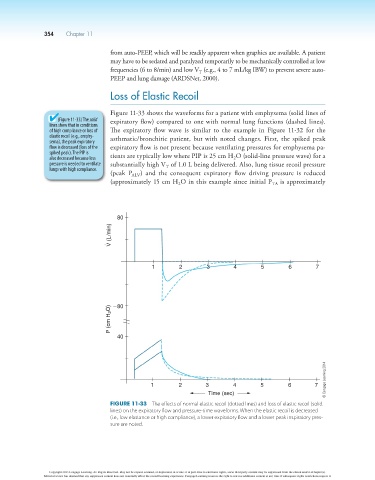
                                            Figure 11-33 shows the waveforms for a patient with emphysema (solid lines of
                          (Figure 11-33) The solid   expiratory flow) compared to one with normal lung functions (dashed lines).
                        lines show that in conditions
                        of high compliance or loss of   The  expiratory  flow  wave  is  similar  to  the  example  in  Figure  11-32  for  the
                        elastic recoil (e.g., emphy-  asthmatic/bronchitic patient, but with noted changes. First, the spiked peak
                        sema), the peak expiratory
                        flow is decreased (loss of the   expiratory flow is not present because ventilating pressures for emphysema pa-
                        spiked peak). The PIP is
                        also decreased because less   tients are typically low where PIP is 25 cm H O (solid-line pressure wave) for a
                                                                                    2
                        pressure is needed to ventilate   substantially high V  of 1.0 L being delivered. Also, lung tissue recoil pressure
                        lungs with high compliance.           T
                                            (peak  P ALV )  and  the  consequent  expiratory  flow  driving  pressure  is  reduced
                                            (approximately 15 cm H O in this example since initial P  is approximately
                                                                  2
                                                                                                TA


                                              80
                                            V (L/min)


                                                         1        2        3        4        5        6        7


                                           P (cm H 2 O)  280


                                              40


                                                                                                                  © Cengage Learning 2014


                                                         1        2        3        4        5        6       7
                                                                            Time (sec)
                                            Figure 11-33  The effects of normal elastic recoil (dotted lines) and loss of elastic recoil (solid
                                            lines) on the expiratory flow and pressure-time waveforms. When the elastic recoil is decreased
                                            (i.e., low elastance or high compliance), a lower expiratory flow and a lower peak inspiratory pres-
                                            sure are noted.


                        Copyright 2013 Cengage Learning. All Rights Reserved. May not be copied, scanned, or duplicated, in whole or in part. Due to electronic rights, some third party content may be suppressed from the eBook and/or eChapter(s).
                      Editorial review has deemed that any suppressed content does not materially affect the overall learning experience. Cengage Learning reserves the right to remove additional content at any time if subsequent rights restrictions require it.

