


Page 389 - Clinical Application of Mechanical Ventilation
P. 389
Ventilator Waveform Analysis  355


                                             10 cm H O), and as a result the peak expiratory flow pattern develops more
                                                      2
                                             slowly and is rounded, and T  is prolonged as demonstrated by the expiratory
                                                                        E
                                             flow and pressure patterns.
                                             Decreased Lung-Thorax Compliance (C )
                                                                                                     LT
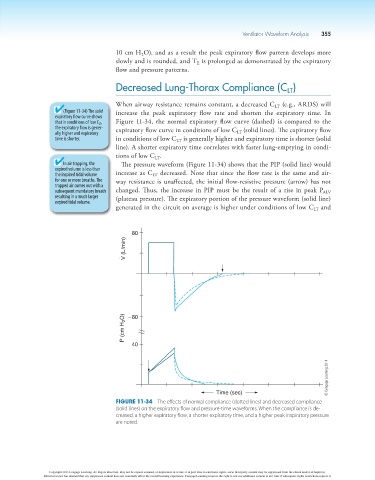
                                             When airway resistance remains constant, a decreased C  (e.g., ARDS) will
                                                                                                 LT
                            (Figure 11-34) The solid   increase  the  peak  expiratory  flow  rate  and  shorten  the  expiratory  time.  In
                          expiratory flow curve shows
                          that in conditions of low C LT ,   Figure 11-34, the normal expiratory flow curve (dashed) is compared to the
                          the expiratory flow is gener-  expiratory flow curve in conditions of low C (solid lines). The expiratory flow
                          ally higher and expiratory                                 LT
                          time is shorter.   in conditions of low C  is generally higher and expiratory time is shorter (solid
                                                                 LT
                                             line). A shorter expiratory time correlates with faster lung-emptying in condi-
                                             tions of low C .
                                                          LT
                            In air trapping, the   The pressure waveform (Figure 11-34) shows that the PIP (solid line) would
                          expired volume is less than
                          the inspired tidal volume   increase as C  decreased. Note that since the flow rate is the same and air-
                                                         LT
                          for one or more breaths. The   way resistance is unaffected, the initial flow-resistive pressure (arrow) has not
                          trapped air comes out with a
                          subsequent mandatory breath   changed. Thus, the increase in PIP must be the result of a rise in peak P ALV
                          resulting in a much larger   (plateau pressure). The expiratory portion of the pressure waveform (solid line)
                          expired tidal volume.
                                             generated in the circuit on average is higher under conditions of low C  and
                                                                                                              LT


                                                   80
                                                V (L/min)


                                                P (cm H 2 O)  280


                                                   40


                                                                                                                  © Cengage Learning 2014


                                                                              Time (sec)
                                             Figure 11-34  The effects of normal compliance (dotted lines) and decreased compliance
                                             (solid lines) on the expiratory flow and pressure-time waveforms. When the compliance is de-
                                             creased, a higher expiratory flow, a shorter expiratory time, and a higher peak inspiratory pressure
                                             are noted.


                        Copyright 2013 Cengage Learning. All Rights Reserved. May not be copied, scanned, or duplicated, in whole or in part. Due to electronic rights, some third party content may be suppressed from the eBook and/or eChapter(s).
                      Editorial review has deemed that any suppressed content does not materially affect the overall learning experience. Cengage Learning reserves the right to remove additional content at any time if subsequent rights restrictions require it.

