


Page 251 - Cardiac Nursing
P. 251
q
                           xd
                          q
                          q
                           xd
                              0/0
                              0/0
                             3
                             3
                    21
                    21
                                                27
                                                27
                                               e 2
                        44.
                        44.
                      1-2
                      1-2
                                          M
                                          M
                                        7 A
                                        7 A
                                            Pa
                                              g
                                              g
                                            Pa
                                              g
                                6/2
                                  009
                                               e 2
                                6/2
                                  009
                                      0:4
                                      0:4
                                     1
                                     1
         LWBK340-c10_
                                                     ara
         LWB K34 0-c 10_ p p pp211-244.qxd  30/06/2009  10:47 AM  Page 227 Aptara
         LWB
               0-c
                 10_
                                                     ara
            K34
                                                   p
                                                   p
                                                   p
                                                  A
                                                  A
                                                    t
                                                    t
                                                               C HAPTER 1 0 / History Taking and Physical Examination  227
                                                                       further assessment of the patient’s cardiovascular status may be
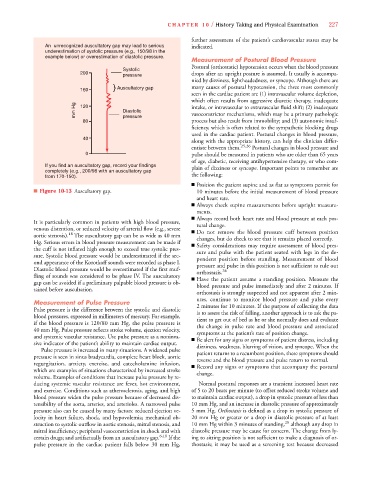
                       An  unrecognized auscultatory gap may lead to serious  indicated.
                       underestimation of systolic pressure (e.g., 150/98 in the
                       example below) or overestimation of diastolic pressure.
                                                                       Measurement of Postural Blood Pressure
                                                                       Postural (orthostatic) hypotension occurs when the blood pressure
                                                Systolic
                                  200           pressure               drops after an upright posture is assumed. It usually is accompa-
                                                                       nied by dizziness, lightheadedness, or syncope. Although there are
                                  160        } Auscultatory gap        many causes of postural hypotension, the three most commonly
                                                                       seen in the cardiac patient are (1) intravascular volume depletion,
                                                                       which often results from aggressive diuretic therapy, inadequate
                                 mm Hg  120     Diastolic              intake, or intravascular to extravascular fluid shift; (2) inadequate
                                                                       vasoconstrictor mechanisms, which may be a primary pathologic
                                   80           pressure               process but also result from immobility; and (3) autonomic insuf-
                                                                       ficiency, which is often related to the sympathetic blocking drugs
                                                                       used in the cardiac patient. Postural changes in blood pressure,
                                   40
                                                                       along with the appropriate history, can help the clinician differ-
                                                                       entiate between them. 25,26  Postural changes in blood pressure and
                                    0                                  pulse should be measured in patients who are older than 65 years
                                                                       of age, diabetic, receiving antihypertensive therapy, or who com-
                       If you find an auscultatory gap, record your findings
                       completely (e.g., 200/98 with an auscultatory gap  plain of dizziness or syncope. Important points to remember are
                       from 170-150).                                  the following:
                                                                       ■ Position the patient supine and as flat as symptoms permit for
                   ■ Figure 10-13 Auscultatory gap.                     10 minutes before the initial measurement of blood pressure
                                                                        and heart rate.
                                                                       ■ Always check supine measurements before upright measure-
                                                                        ments.
                                                                       ■ Always record both heart rate and blood pressure at each pos-
                   It is particularly common in patients with high blood pressure,  tural change.
                   venous distention, or reduced velocity of arterial flow (e.g., severe  ■ Do not remove the blood  pressure cuff between  position
                              18
                   aortic stenosis). The auscultatory gap can be as wide as 40 mm  changes, but do check to see that it remains placed correctly.
                   Hg. Serious errors in blood pressure measurement can be made if
                                                                       ■ Safety considerations may require assessment of blood pres-
                   the cuff is not inflated high enough to exceed true systolic pres-  sure and pulse with the patient seated with legs in the de-
                   sure. Systolic blood pressure would be underestimated if the sec-  pendent position  before standing. Measurement of  blood
                   ond appearance of the Korotkoff sounds were recorded as phase I.  pressure and pulse in this position is not sufficient to rule out
                   Diastolic blood pressure would be overestimated if the first muf-  orthostasis. 26
                   fling of sounds was considered to be phase IV. The auscultatory
                                                                       ■ Have the patient assume a standing position. Measure the
                   gap can be avoided if a preliminary palpable blood pressure is ob-  blood pressure and pulse immediately and after 2 minutes. If
                   tained before auscultation.
                                                                        orthostasis is strongly suspected and not apparent after 2 min-
                                                                        utes, continue to monitor  blood pressure and pulse every
                   Measurement of Pulse Pressure                        2 minutes for 10 minutes. If the purpose of collecting the data
                   Pulse pressure is the difference between the systolic and diastolic  is to assess the risk of falling, another approach is to ask the pa-
                   blood pressures, expressed in millimeters of mercury. For example,  tient to get out of bed as he or she normally does and evaluate
                   if the blood pressure is 120/80 mm Hg, the pulse pressure is   the change in pulse rate and blood pressure and associated
                   40 mm Hg. Pulse pressure reflects stroke volume, ejection velocity,  symptoms at the patient’s rate of position change.
                   and systemic vascular resistance. Use pulse pressure as a noninva-
                                                                       ■ Be alert for any signs or symptoms of patient distress, including
                   sive indicator of the patient’s ability to maintain cardiac output.  dizziness, weakness, blurring of vision, and syncope. When the
                     Pulse pressure is increased in many situations. A widened pulse  patient returns to a recumbent position, these symptoms should
                   pressure is seen in sinus bradycardia, complete heart block, aortic  reverse and the blood pressure and pulse return to normal.
                   regurgitation, anxiety, exercise, and catecholamine infusion,
                                                                       ■ Record any signs or symptoms that accompany the postural
                   which are examples of situations characterized by increased stroke  change.
                   volume. Examples of conditions that increase pulse pressure by re-
                   ducing systemic vascular resistance are fever, hot environment,  Normal postural responses are a transient increased heart rate
                   and exercise. Conditions such as atherosclerosis, aging, and high  of 5 to 20 beats per minute (to offset reduced stroke volume and
                   blood pressure widen the pulse pressure because of decreased dis-  to maintain cardiac output), a drop in systolic pressure of less than
                   tensibility of the aorta, arteries, and arterioles. A narrowed pulse  10 mm Hg, and an increase in diastolic pressure of approximately
                   pressure also can be caused by many factors: reduced ejection ve-  5 mm Hg. Orthostasis is defined as a drop in systolic pressure of
                   locity in heart failure, shock, and hypovolemia; mechanical ob-  20 mm Hg or greater or a drop in diastolic pressure of at least
                   struction to systolic outflow in aortic stenosis, mitral stenosis, and  10 mm Hg within 3 minutes of standing, 26  although any drop in
                   mitral insufficiency; peripheral vasoconstriction in shock and with  diastolic pressure may be cause for concern. The change from ly-
                   certain drugs; and artifactually from an auscultatory gap. 6,18  If the  ing to sitting position is not sufficient to make a diagnosis of or-
                   pulse pressure in the cardiac patient falls below 30 mm Hg,  thostasis; it may be used as a screening test because decreased

