


Page 250 - Cardiac Nursing
P. 250
LWBK340-c10_p211-244.qxd  30/06/2009  10:46 AM  Page 226 Aptara


                  226    PA R T  III / Assessment of Heart Disease

                    160
                                                   Artery
                                                   occluded,        Silence
                                                   no flow

                                                                      Systolic
                    120
                                                                      pressure
                                                   Artery
                                                   compressed,
                    mm Hg                          blood flow       Sounds of
                                                                    turbulent flow
                                                   audible
                                                                      Diastolic
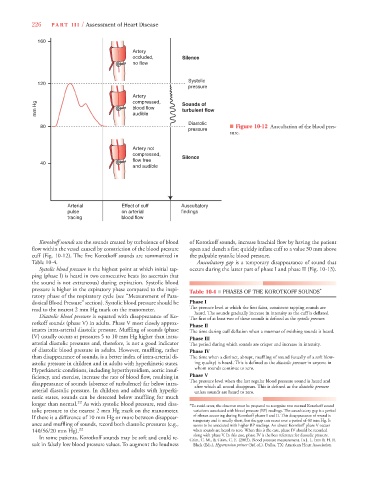
                     80                                                            ■ Figure 10-12 Auscultation of the blood pres-
                                                                      pressure
                                                                                   sure.
                                                   Artery not
                                                   compressed,
                                                                    Silence
                                                   flow free
                     40
                                                   and audible


                              Arterial          Effect of cuff     Auscultatory
                              pulse             on arterial        findings
                              tracing           blood flow


                     Korotkoff sounds are the sounds created by turbulence of blood  of Korotkoff sounds, increase brachial flow by having the patient
                  flow within the vessel caused by constriction of the blood pressure  open and clench a fist; quickly inflate cuff to a value 30 mm above
                  cuff (Fig. 10-12). The five Korotkoff sounds are summarized in  the palpable systolic blood pressure.
                  Table 10-4.                                           Auscultatory gap is a temporary disappearance of sound that
                     Systolic blood pressure is the highest point at which initial tap-  occurs during the latter part of phase I and phase II (Fig. 10-13).
                  ping (phase I) is heard in two consecutive beats (to ascertain that
                  the sound is not extraneous) during expiration. Systolic blood
                  pressure is higher in the expiratory phase compared to the inspi-  Table 10-4 ■ PHASES OF THE KOROTKOFF SOUNDS *
                  ratory phase of the respiratory cycle (see “Measurement of Para-
                  doxical Blood Pressure” section). Systolic blood pressure should be  Phase I
                  read to the nearest 2 mm Hg mark on the manometer.  The pressure level at which the first faint, consistent tapping sounds are
                                                                        heard. The sounds gradually increase in intensity as the cuff is deflated.
                     Diastolic blood pressure is equated with disappearance of Ko-  The first of at least two of these sounds is defined as the systolic pressure.
                  rotkoff sounds (phase V) in adults. Phase V most closely approx-  Phase II
                  imates intra-arterial diastolic pressure. Muffling of sounds (phase  The time during cuff deflation when a murmur of swishing sounds is heard.
                  IV) usually occurs at pressures 5 to 10 mm Hg higher than intra-  Phase III
                  arterial diastolic pressures and, therefore, is not a good indicator  The period during which sounds are crisper and increase in intensity.
                  of diastolic blood pressure in adults. However, muffling, rather  Phase IV
                  than disappearance of sounds, is a better index of intra-arterial di-  The time when a distinct, abrupt, muffling of sound (usually of a soft blow-
                  astolic pressure in children and in adults with hyperkinetic states.  ing quality) is heard. This is defined as the diastolic pressure in anyone in
                  Hyperkinetic conditions, including hyperthyroidism, aortic insuf-  whom sounds continue to zero.
                  ficiency, and exercise, increase the rate of blood flow, resulting in  Phase V
                  disappearance of sounds (absence of turbulence) far below intra-  The pressure level when the last regular blood pressure sound is heard and
                                                                        after which all sound disappears. This is defined as the diastolic pressure
                  arterial diastolic pressure. In children and adults with hyperki-  unless sounds are heard to zero.
                  netic states, sounds can be detected below muffling for much
                  longer than normal. 22  As with systolic blood pressure, read dias-  *To avoid error, the observer must be prepared to recognize two normal Korotkoff sound
                  tolic pressure to the nearest 2 mm Hg mark on the manometer.  variations associated with blood pressure (BP) readings. The auscultatory gap is a period
                  If there is a difference of 10 mm Hg or more between disappear-  of silence occurring during Korotkoff phases I and II. This disappearance of sound is
                                                                       temporary and is usually short, but the gap can occur over a period of 40 mm Hg. It
                  ance and muffling of sounds, record both diastolic pressures (e.g.,  seems to be associated with higher BP readings. An absent Korotkoff phase V occurs
                  140/56/20 mm Hg). 22                                 when sounds are heard to zero. When this is the case, phase IV should be recorded
                                                                       along with phase V. In this case, phase IV is the best reference for diastolic pressure.
                     In some patients, Korotkoff sounds may be soft and could re-
                                                                      Grim, C. M., & Grim, C. E. (2003). Blood pressure measurement. In J. L. Izzo & H. R.
                  sult in falsely low blood pressure values. To augment the loudness  Black (Eds.), Hypertension primer (3rd ed.). Dallas, TX: American Heart Association.

