


Page 252 - Cardiac Nursing
P. 252
21
                    21
                   p
                                              g
                   p
                                              g
                        44.
                          q
                        44.
                      1-2
                      1-2
                                               e 2
                                                   p
                                                   p
                                                    t
                                                     ara
                                                    t
                                                   p
                                                28
                                               e 2
                                                28
                                                  A
                                                  A
                                      0:4
                                        7 A
                                      0:4
                                     1
                                     1
                                        7 A
                                            Pa
                                              g
                                            Pa
                                          M
                                          M
                                  009
                           xd
                             3
                           xd
                          q
                          q
                             3
                                6/2
                                  009
                                6/2
                              0/0
                              0/0
            K34
               0-c
                 10_
         LWBK340-c10_
                                                     ara
         LWB K34 0-c 10_ pp211-244.qxd  30/06/2009  10:47 AM  Page 228 Aptara
         LWB
                  228    P A R T  III / Assessment of Heart Disease
                  blood pressure, increased pulse, or symptoms in the sitting
                  position presage similar events in the erect position. Often, the
                  change in blood pressure does not meet the criteria for orthosta-
                  sis, but it is accompanied by a significant change in heart rate or
                  associated symptoms, or both. These circumstances identify peo-
                  ple at risk and should prompt further investigation by the cardiac
                  nurse of the patient’s present volume status and vasodilatory or
                  cardioinhibitory drug regimen.
                     The presence of intravascular volume depletion (such as with
                  diuretic therapy) should be suspected when, in response to sit-
                  ting or standing, the heart rate increases and the systolic pressure
                  decreases by 15 mm Hg and the diastolic blood pressure drops
                  by 10 mm Hg. 26  It is difficult to differentiate intravascular vol-
                  ume loss from inadequate vasoconstrictor mechanisms solely by
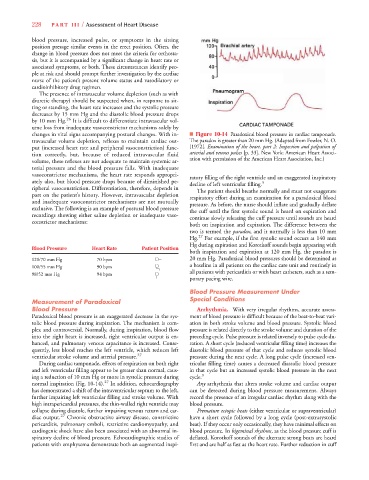
                  changes in vital signs accompanying postural changes. With in-  ■ Figure 10-14 Paradoxical blood pressure in cardiac tamponade.
                  travascular volume depletion, reflexes to maintain cardiac out-  The paradox is greater than 20 mm Hg. (Adapted from Fowler, N. O.
                  put (increased heart rate and peripheral vasoconstriction) func-  [1972]. Examination of the heart, part 2: Inspection and palpation of
                  tion correctly,  but,  because of reduced intravascular  fluid  arterial and venous pulses [p. 33]. New York: American Heart Associ-
                  volume, these reflexes are not adequate to maintain systemic ar-  ation with permission of the American Heart Association, Inc.)
                  terial pressure and the blood pressure falls. With inadequate
                  vasoconstrictor mechanisms, the heart rate responds appropri-  ratory filling of the right ventricle and an exaggerated inspiratory
                  ately also, but blood pressure drops because of diminished pe-  decline of left ventricular filling. 5
                  ripheral vasoconstriction. Differentiation, therefore, depends in  The patient should breathe normally and must not exaggerate
                  part on the patient’s history. However, intravascular depletion  respiratory effort during an examination for a paradoxical blood
                  and inadequate vasoconstrictor mechanisms are not mutually  pressure. As before, the nurse should inflate and gradually deflate
                  exclusive. The following is an example of postural blood pressure  the cuff until the first systolic sound is heard on expiration and
                  recordings showing either saline depletion or inadequate vaso-  continue slowly releasing the cuff pressure until sounds are heard
                  constrictor mechanisms:
                                                                      both on inspiration and expiration. The difference between the
                                                                      two is termed the paradox, and it normally is less than 10 mm
                                                                      Hg. 27  For example, if the first systolic sound occurs at 140 mm
                                                                      Hg during expiration and Korotkoff sounds begin appearing with
                  Blood Pressure      Heart Rate      Patient Position
                                                                      both inspiration and expiration at 120 mm Hg, the paradox is
                  120/70 mm Hg          70 bpm                        20 mm Hg. Paradoxical blood pressures should be determined as
                  100/55 mm Hg          90 bpm                        a baseline in all patients on the cardiac care unit and routinely in
                                                                      all patients with pericarditis or with heart catheters, such as a tem-
                  98/52 mm Hg           94 bpm
                                                                      porary pacing wire.
                                                                      Blood Pressure Measurement Under
                                                                      Special Conditions
                  Measurement of Paradoxical
                  Blood Pressure                                        Arrhythmia. With very irregular rhythms, accurate assess-
                  Paradoxical blood pressure is an exaggerated decrease in the sys-  ment of blood pressure is difficult because of the beat-to-beat vari-
                  tolic blood pressure during inspiration. The mechanism is com-  ation in both stroke volume and blood pressure. Systolic blood
                  plex and controversial. Normally, during inspiration, blood flow  pressure is related directly to the stroke volume and duration of the
                  into the right heart is increased, right ventricular output is en-  preceding cycle. Pulse pressure is related inversely to pulse cycle du-
                  hanced, and pulmonary venous capacitance is increased. Conse-  ration. A short cycle (reduced ventricular filling time) increases the
                  quently, less blood reaches the left ventricle, which reduces left  diastolic blood pressure of that cycle and reduces systolic blood
                  ventricular stroke volume and arterial pressure. 27  pressure during the next cycle. A long pulse cycle (increased ven-
                     During cardiac tamponade, effects of respiration on both right  tricular filling time) causes a decreased diastolic blood pressure
                  and left ventricular filling appear to be greater than normal, caus-  in that cycle but an increased systolic blood pressure in the next
                  ing a reduction of 10 mm Hg or more in systolic pressure during  cycle. 3
                  normal inspiration (Fig. 10-14). 27  In addition, echocardiography  Any arrhythmia that alters stroke volume and cardiac output
                  has demonstrated a shift of the intraventricular septum to the left,  can be detected during blood pressure measurement. Always
                  further impairing left ventricular filling and stroke volume. With  record the presence of an irregular cardiac rhythm along with the
                  high intrapericardial pressures, the thin-walled right ventricle may  blood pressure.
                  collapse during diastole, further impairing venous return and car-  Premature ectopic beats (either ventricular or supraventricular)
                  diac output. 27  Chronic obstructive airway disease, constrictive  have a short cycle followed by a long cycle (post-extrasystolic
                  pericarditis, pulmonary emboli, restrictive cardiomyopathy, and  beat). If they occur only occasionally, they have minimal effects on
                  cardiogenic shock have also been associated with an abnormal in-  blood pressure. In bigeminal rhythms, as the blood pressure cuff is
                  spiratory decline of blood pressure. Echocardiographic studies of  deflated, Korotkoff sounds of the alternate strong beats are heard
                  patients with emphysema demonstrate both an augmented inspi-  first and are half as fast as the heart rate. Further reduction in cuff

