


Page 254 - Cardiac Nursing
P. 254
0/0
                                6/2
                              0/0
                             3
                             3
                                6/2
                                     1
                                      0:4
                                     1
                                  009
                                  009
                           xd
                      1-2
                      1-2
                    21
                   p
                    21
                        44.
                          q
                           xd
                          q
                        44.
                          q
                                                  A
                                                   p
                                                  A
                                                30
                                                30
                                                   p
                                                     ara
                                                     ara
                                                    t
                                                   p
                                                    t
                                               e 2
                                          M
                                          M
                                        7 A
                                      0:4
                                        7 A
                                            Pa
                                              g
                                               e 2
                                              g
                                            Pa
                                              g
         LWB
            K34
         LWB K34 0-c 10_ pp211-244.qxd  30/06/2009  10:47 AM  Page 230 Aptara
         LWBK340-c10_
                 10_
               0-c
                   p
                  230    P A R T  III / Assessment of Heart Disease
                                                                                                     6
                      a                                b       c      edema, or increased capillary permeability. In the cardiac patient,
                             b                                        peripheral edema frequently occurs because of sodium and water
                                   c            a
                                                                      retention and right-sided heart failure. Bilateral edema of the lower
                                                                      extremities suggests a systemic etiology; unilateral edema is usually
                                                                      the result of a local etiology. A weight gain of 10 lb (indicative of
                   A   abc < 180 °                    abc > 195 °     5 L of extracellular fluid volume) precedes visible edema in most
                                                                      patients. Interstitial edema occurs in the most dependent part of
                                                                      the body, its location varying with the patient’s posture. With sit-
                                                                      ting or standing, edema develops in the lower extremities. With
                     IPD                                              bedrest, edema forms in the sacrum. Because the distribution of
                            DPD                       DPD     IPD
                                                                      edema fluid varies with position, daily weights provide the best se-
                                                                      rial assessment of edema. Pitting edema is a depression in the skin
                                                                      from pressure. To demonstrate the presence of pitting edema, the
                                                                      nurse presses firmly with his or her thumb over a bony surface such
                   B   DPD < IPD                      DPD > IPD       as the sacrum, medial malleolus, the dorsum of each foot, and the
                                                                      shins. When the thumb is withdrawn, an indentation persists for a
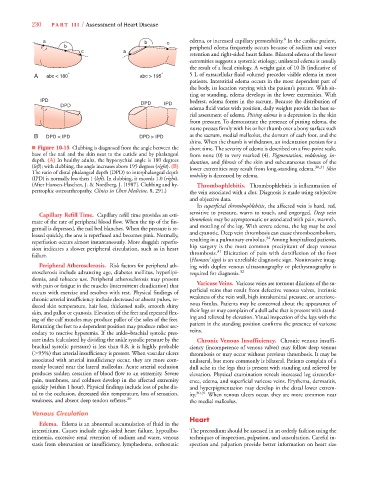
                  ■ Figure 10-15 Clubbing is diagnosed from the angle between the  short time. The severity of edema is described on a five-point scale,
                  base of the nail and the skin next to the cuticle and by phalangeal  from none (0) to very marked (4). Pigmentation, reddening, g in-
                                                                                                                  g
                  depth. (A) In healthy adults, the hyponychial angle is 180 degrees  duration, and fibrosis of the skin and subcutaneous tissues of the
                     t
                     t
                                                              t
                                                              t
                  (left); with clubbing, the angle increases above 195 degrees (right). (B)  lower extremities may result from long-standing edema. 30,31  Skin
                  The ratio of distal phalangeal depth (DPD) to interphalangeal depth  mobility is decreased by edema.
                                                                 t
                  (IPD) is normally less then 1 (left). In clubbing, it exceeds 1.0 (t t  right).
                                                                 t
                  (After Hansen-Flaschen, J. & Nordberg, J. [1987]. Clubbing and hy-  Thrombophlebitis. Thrombophlebitis is inflammation of
                  pertrophic osteoarthropathy. Clinics in Chest Medicine, 8, 291.)  the vein associated with a clot. Diagnosis is made using subjective
                                                                      and objective data.
                                                                        In superficial thrombophlebitis, the affected vein is hard, red,
                                                                      sensitive to pressure, warm to touch, and engorged. Deep vein
                     Capillary Refill Time. Capillary refill time provides an esti-
                  mate of the rate of peripheral blood flow. When the tip of the fin-  thrombosis may be asymptomatic or associated with pain, warmth,
                  gernail is depressed, the nail bed blanches. When the pressure is re-  and mottling of the leg. With severe edema, the leg may be cool
                  leased quickly, the area is reperfused and becomes pink. Normally,  and cyanotic. Deep vein thrombosis can cause thromboembolism,
                                                                                               32
                  reperfusion occurs almost instantaneously. More sluggish reperfu-  resulting in a pulmonary embolus. Among hospitalized patients,
                  sion indicates a slower peripheral circulation, such as in heart  hip surgery is the most common precipitant of deep venous
                                                                               31
                  failure.                                            thrombosis.  Elicitation of pain with dorsiflexion of the foot
                                                                      (Homans’ sign) is an unreliable diagnostic sign. Noninvasive imag-
                     Peripheral Atherosclerosis. Risk factors for peripheral ath-  ing with duplex venous ultrasonography or plethysmography is
                  erosclerosis include advancing age, diabetes mellitus, hyperlipi-  required for diagnosis. 32
                  demia, and tobacco use. Peripheral atherosclerosis may present
                  with pain or fatigue in the muscles (intermittent claudication) that  Varicose Veins. Varicose veins are tortuous dilations of the su-
                  occurs with exercise and resolves with rest. Physical findings of  perficial veins that result from defective venous valves, intrinsic
                  chronic arterial insufficiency include decreased or absent pulses, re-  weakness of the vein wall, high intraluminal pressure, or arteriove-
                  duced skin temperature, hair loss, thickened nails, smooth shiny  nous fistulas. Patients may be concerned about the appearance of
                  skin, and pallor or cyanosis. Elevation of the feet and repeated flex-  their legs or may complain of a dull ache that is present with stand-
                  ing of the calf muscles may produce pallor of the soles of the feet.  ing and relieved by elevation. Visual inspection of the legs with the
                  Returning the feet to a dependent position may produce rubor sec-  patient in the standing position confirms the presence of varicose
                  ondary to reactive hyperemia. If the ankle–brachial systolic pres-  veins.
                  sure index (calculated by dividing the ankle systolic pressure by the  Chronic Venous Insufficiency. Chronic venous insuffi-
                  brachial systolic pressure) is less than 0.8, it is highly probable  ciency (incompetence of venous valves) may follow deep venous
                  ( 95%) that arterial insufficiency is present. When vascular ulcers  thrombosis or may occur without previous thrombosis. It may be
                  associated with arterial insufficiency occur, they are more com-  unilateral, but more commonly is bilateral. Patients complain of a
                  monly located near the lateral malleolus. Acute arterial occlusion  dull ache in the legs that is present with standing and relieved by
                  produces sudden cessation of blood flow to an extremity. Severe  elevation. Physical examination reveals increased leg circumfer-
                  pain, numbness, and coldness develop in the affected extremity  ence, edema, and superficial varicose veins. Erythema, dermatitis,
                  quickly (within 1 hour). Physical findings include loss of pulse dis-  and hyperpigmentation may develop in the distal lower extrem-
                  tal to the occlusion, decreased skin temperature, loss of sensation,  ity. 30,31  When venous ulcers occur, they are more common near
                  weakness, and absent deep tendon reflexes. 30        the medial malleolus.
                  Venous Circulation
                                                                      Heart
                     Edema. Edema is an abnormal accumulation of fluid in the
                  interstitium. Causes include right-sided heart failure, hypoalbu-  The precordium should be assessed in an orderly fashion using the
                  minemia, excessive renal retention of sodium and water, venous  techniques of inspection, palpation, and auscultation. Careful in-
                  stasis from obstruction or insufficiency, lymphedema, orthostatic  spection and palpation provide better information on heart size

