


Page 255 - Cardiac Nursing
P. 255
009
                                  009
                                6/2
                              0/0
                                6/2
                                      0:4
                                        7 A
                                      0:4
                                     1
                                     1
                          q
                          q
                          q
                        44.
                        44.
                             3
                              0/0
                             3
                           xd
                           xd
                                        7 A
                                                   p
                                                   p
                                                  A
                                                31
                                                  A
                                                     ara
                                                     ara
                                                    t
                                                   p
                                                    t
                                            Pa
                                              g
                                            Pa
                                          M
                                          M
                                               e 2
                                                31
                                               e 2
                                              g
                                              g
         LWBK340-c10_
         LWB
         LWB K34 0-c 10_ pp211-244.qxd  30/06/2009  10:47 AM  Page 231 Aptara
                 10_
               0-c
            K34
                   p
                    21
                      1-2
                      1-2
                    21
                   p
                                                               C HAPTER 1 0 / History Taking and Physical Examination  231
                   than does percussion. Percussion is most useful in the rare in-  centimeters from the sternum or the MCL. Determine whether it
                                               6
                   stance where dextrocardia is suspected. The room should be quiet  occurs in systole or diastole by timing it with the carotid pulse or
                   and permit privacy. Both the patient and the examiner should be  the heart sounds. In general, retractions are more easily seen, and
                   in comfortable positions before beginning the examination.  pulsations are more easily palpated.
                                                                         When visible, the normal apex impulse can be seen within the
                   Topographic Anatomy                                 fifth ICS at or just medial to the MCL. It is an early systolic pul-
                                                                       sation with a rapid upstroke and downstroke. A late systolic re-
                   Knowledge of the topographic anatomy of the cardiac and vas-  traction, 1 to 2 cm long, in the fourth or fifth ICS may also be
                   cular structures is essential to understanding the clinical find-  normally seen and is produced by ventricular emptying. The apex
                   ings. The left ventricle is primarily a posterior structure and is  impulse cannot be seen in every patient. It is easily detected in
                   evaluated on the anterior chest wall at the cardiac apex, which is  thin patients, whereas it may not be visible in those who are obese
                   normally in the fifth intercostal space (ICS) at, or slightly me-  or have large breasts or barrel chests. An apex impulse that is be-
                   dial to, the mid-clavicular line (MCL). The right ventricle is an-  low the fifth ICS, lateral to the MCL, or seen in more than one
                   terior to the left ventricle and underlies the sternum and the  ICS represents left ventricular enlargement.
                   lower left sternal border at the fourth and fifth ICS. The right  Slight movement over the sternum or the epigastrium can be
                   atrium is just lateral to the lower right sternal border. The out-  normal in thin people and in those with fever or anemia who may
                   flow tracts of both ventricles underlie the third left ICS (Erb’s  have hyperdynamic heartbeats. A sternal rise that is sustained after
                   point). The main pulmonary artery underlies the second left ICS,  systole begins usually indicates right ventricular enlargement. Pul-
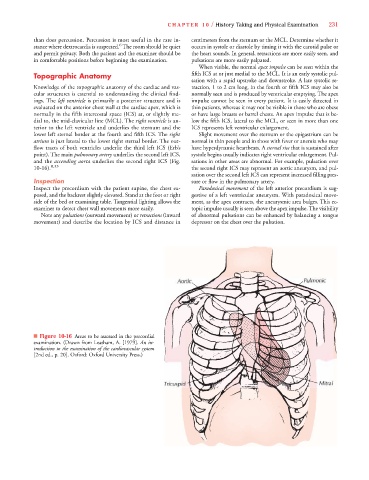
                   and the ascending aorta underlies the second right ICS (Fig.  sations in other areas are abnormal. For example, pulsation over
                   10-16). 8,33                                        the second right ICS may represent an aortic aneurysm, and pul-
                                                                       sation over the second left ICS can represent increased filling pres-
                   Inspection                                          sure or flow in the pulmonary artery.
                   Inspect the precordium with the patient supine, the chest ex-  Paradoxical movement of the left anterior precordium is sug-
                   posed, and the backrest slightly elevated. Stand at the foot or right  gestive of a left ventricular aneurysm. With paradoxical move-
                   side of the bed or examining table. Tangential lighting allows the  ment, as the apex contracts, the aneurysmic area bulges. This ec-
                   examiner to detect chest wall movements more easily.  topic impulse usually is seen above the apex impulse. The visibility
                     Note any pulsations (outward movement) or retractions (inward  of abnormal pulsations can be enhanced by balancing a tongue
                   movement) and describe the location by ICS and distance in  depressor on the chest over the pulsation.
                   ■ Figure 10-16 Areas to be assessed in the precordial
                   examination. (Drawn from Leatham, A. [1979]. An in-
                   troduction to the examination of the cardiovascular system
                   [2nd ed., p. 20]. Oxford: Oxford University Press.)

