


Page 256 - Cardiac Nursing
P. 256
p
                   p
                                                   p
                                                    t
                                                    t
                    21
                      1-2
                      1-2
                                                   p
                    21
                                               e 2
                                                     ara
                                              g
                                                32
                                              g
                                            Pa
                                            Pa
                                               e 2
                                                32
                                                     ara
                                                  A
                                                   p
                                                  A
                        44.
                                     1
                                     1
                                  009
                                6/2
                                  009
                                      0:4
                                          M
                                          M
                                        7 A
                                      0:4
                                        7 A
                                6/2
                          q
                           xd
                          q
                        44.
                          q
                           xd
                              0/0
                              0/0
                             3
                                              g
                             3
               0-c
               0-c
                 10_
                 10_
            K34
         LWB
         LWBK340-c10_ pp211-244.qxd  30/06/2009  10:47 AM  Page 232 Aptara
            K34
         LWB
                  232    P A R T  III / Assessment of Heart Disease
                  Palpation                                             The parts of the stethoscope are the ear pieces, tubing, and
                  Movement that was not visible on inspection may be detected by  chest pieces. The ear pieces should fit comfortably into the ear
                  palpation. All areas should be palpated using either the ball of the  canal and be snug enough so that extraneous sound cannot enter.
                  palm (at the base of the fingers) or the fingertips. In general, the  They also must be kept free of ear wax. Double tubing with a
                  palm surface is more sensitive to thrills (vibrations), whereas fin-  small internal diameter (3 mm) should extend from the ear pieces
                  gertips are more sensitive to pulsations. Thrills indicate turbulence  to the chest pieces. In addition, the tubing should be reasonably
                  of blood flow and are associated with murmurs. Impulses are de-  short (25 to 30 cm) so the sound is not diluted and should be
                  scribed in terms of location, size, amplitude, duration, and time in  thick to minimize room noise. 33
                  the cardiac cycle (systole or diastole). To facilitate measurement of  There are two classic types of chest pieces, the diaphragm
                  the horizontal location in centimeters from the MCL, or the size  and the bell. The diaphragm, which brings out higher frequen-
                  of the impulse, it is helpful for the examiner to measure his or her  cies and filters out the lower ones, is useful for listening to the
                  hand and use it as a “ruler.” For example, the distance from the tip  first and second heart sounds (S 1 and S 2 ), high-frequency mur-
                  of the finger to the first joint, the second joint, and the third joint  murs, and lung sounds. The diaphragm should be pressed
                  can be used.                                        firmly against the chest wall. The bell filters out high-frequency
                     Assess the apex impulse for location, size, amplitude, and du-  sounds and accentuates the low-frequency ones. Diastolic fill-
                  ration. The apex impulse is, by definition, the furthest point left-  ing sounds and the low-frequency murmurs of mitral and tri-
                  ward and downward at which a cardiac pulsation can be seen or  cuspid stenosis are heard best with the bell. 33  The bell should
                     3
                  felt. The normal apex impulse is felt as a light tap, extending over  rest lightly on the chest; if firm pressure is applied, the skin be-
                  3 cm or less. The apex impulse is felt immediately after the first  comes taut and acts like a diaphragm. When auscultating heart
                  heart sound and lasts halfway through systole. An impulse that is  sounds, the nurse stands on the patient’s right side so that, as he
                  diffuse (felt over two ICSs), increased in amplitude, or laterally or  or she places the bell of the stethoscope on the patient’s chest,
                  inferiorly displaced suggests increased volume load and left ven-  the chest piece is balanced. Because the bell does not have to be
                  tricular dilatation, such as occurs in mitral insufficiency or left  held in place, the possibilities of creating extraneous sounds and
                  ventricular failure. An impulse that is sustained, enlarged, and,  filtering out low frequencies are reduced. Some stethoscopes
                  sometimes, laterally displaced suggests obstruction to outflow  have a single chestpiece with tunable diaphragm. Very light skin
                  with increased ventricular pressure load and concentric hypertro-  contact is used to listen to low-frequency sounds and firm pres-
                  phy of the muscle, such as occurs in aortic stenosis or systemic  sure is used to listen to high-frequency sounds.
                            6
                  hypertension. If the apex impulse cannot be felt with the patient  As part of a cardiac examination, all areas identified in Figure
                  lying supine, examine the patient in the left lateral position, which  10-17 should be auscultated except the epigastrium. The listener’s
                  brings the apex of the heart against the chest wall; the quality of  goals when auscultating the precordium are to identify normal
                  the apex beat still can be determined even though its size and po-  heart sounds, the heart rate, and rhythm; extra diastolic and sys-
                  sition may be slightly altered. A diastolic outward pulsation indi-  tolic sounds; murmurs; and pericardial friction rubs.
                  cates impaired ventricular filling and corresponds to an S 3 (early  Technique. The stethoscope is placed directly on the chest
                  to mid-diastole) or S 4 (late diastole) heard on auscultation.  wall; adequate auscultation of the heart and lungs through cloth-
                     Next, palpate the right ventricular area. The presence of a pul-  ing is impossible. The room should be quiet; the patient and ex-
                  sation suggests right ventricular enlargement. Palpation of the epi-  aminer should be comfortable. Cardiac auscultation should be
                  gastrium, by placing the palmar surface of the hand over the area  performed with the patient in three positions: supine, lying par-
                  and sliding the fingers toward the xiphoid, can also detect right  tially on the left side, and sitting up, leaning forward. The exam-
                  ventricular enlargement. Pulsations beating down on the finger-  iner can begin listening either at the cardiac apex or at the base.
                  tips indicate right ventricular movement. Pulsations pushing up-  Beginning at the apex allows the examiner to focus initially on the
                  ward against the hand originate in the aorta. An increased aortic  first heart sound, clearly identify systole and diastole, and think
                  pulse could indicate abdominal aortic aneurysm or aortic regurgi-  through the cardiac cycle while listening at each site. The apex is
                  tation. Hepatic pulsations may be felt in the epigastrium but also  the location of the apex impulse identified by palpation. Remem-
                  over the right upper abdomen. The liver may pulsate with tricus-  ber that left ventricular enlargement shifts the apex from the nor-
                  pid valve disease, severe right ventricular failure, or pulmonary hy-  mal location. The timing of extra sounds in the cardiac cycle, the
                           3
                  pertension. A thrill at the lower left sternal border suggests tri-  location in which they are best heard, and the quality of the sound
                  cuspid valve disease.                               are used to differentiate one from another.
                     Then, palpate the third left ICS and the second left and right  It is important to proceed in a systematic manner. Inching the
                  ICSs. Systolic pulsations in the second left or right ICS suggest in-  stethoscope up and down the chest wall is a useful technique and
                  creased pressure or enlargement of the pulmonary artery or the  allows the examiner to focus on specific events in the cardiac cy-
                  aorta, respectively; thrills suggest pulmonary or aortic valve ab-  cle (Table 10-5). At each location, listen sequentially to four
                  normalities.
                                                                      events: S 1 , systole (interval between S 1 and S 2 ), S 2 , and diastole
                  Auscultation
                     Stethoscope. A good-quality stethoscope is required for car-  Systole  Diastole  Systole  Systole
                  diac auscultation. Although the human ear is able to hear sounds
                  ranging in frequency from 20 cycles per second, or Hertz (Hz), to
                  20,000 Hz, it is most sensitive to 1,000 to 5,000 Hz. The fre-  S 1  S 2  S 1  S 2      S 1    S 2
                  quency of most heart sounds is less than 1,000 Hz. The stetho-
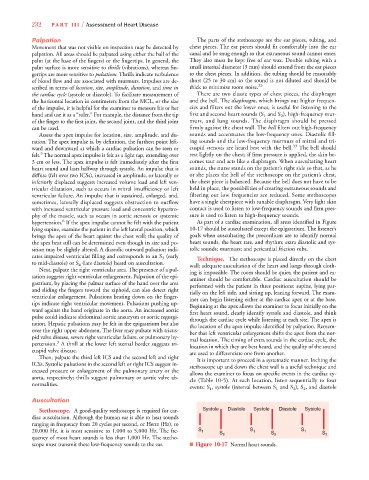
                  scope must transmit these low-frequency sounds to the ear.  ■ Figure 10-17 Normal heart sounds.

