


Page 341 - Cardiac Nursing
P. 341
LWBK340-c15_p300-332.qxd  6/29/09  10:30 PM  Page 317 Aptara Inc.


                                                                                C HAPTER 1 5 / Electrocardiography  317

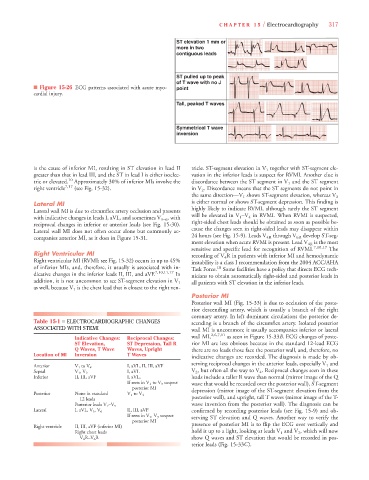
                                                                  ST elevation 1 mm or
                                                                  more in two
                                                                  contiguous leads


                                                                  ST pulled up to peak
                                                                  of T wave with no J
                   ■ Figure 15-26 ECG patterns associated with acute myo-  point
                   cardial injury.
                                                                  Tall, peaked T waves


                                                                  Symmetrical T wave
                                                                  inversion


                   is the cause of inferior MI, resulting in ST elevation in lead II  tricle. ST-segment elevation in V 1 together with ST-segment ele-
                   greater than that in lead III, and the ST in lead I is either isoelec-  vation in the inferior leads is suspect for RVMI. Another clue is
                   tric or elevated. 10  Approximately 30% of inferior MIs involve the  discordance between the ST segment in V 1 and the ST segment
                                                                         V
                   right ventricle 7,17  (see Fig. 15-32).             in V 2 . Discordance means that the ST segments do not point in
                                                                                                                     V
                                                                       the same direction—V 1 shows ST-segment elevation, whereas V 2
                   Lateral MI                                          is either normal or shows ST-segment depression. This finding is
                   Lateral wall MI is due to circumflex artery occlusion and presents  highly likely to indicate RVMI, although rarely the ST segment
                                                                                        V
                   with indicative changes in leads I, aVL, and sometimes V 5–6 , with  will be elevated in V 1 –V 4 in RVMI. When RVMI is suspected,
                   reciprocal changes in inferior or anterior leads (see Fig. 15-30).  right-sided chest leads should be obtained as soon as possible be-
                   Lateral wall MI does not often occur alone but commonly ac-  cause the changes seen in right-sided leads may disappear within
                                                                                              V
                   companies anterior MI, as it does in Figure 15-31.  24 hours (see Fig. 15-9). Leads V 4R through V 6R develop ST-seg-
                                                                       ment elevation when acute RVMI is present. Lead V 4R is the most
                                                                                                           V
                                                                       sensitive and specific lead for recognition of RVMI. 7,10,17  The
                   Right Ventricular MI                                recording of V 4 R in patients with inferior MI and hemodynamic
                                                                                V
                   Right ventricular MI (RVMI; see Fig. 15-32) occurs in up to 45%  instability is a class I recommendation from the 2004 ACC/AHA
                   of inferior MIs, and, therefore, it usually is associated with in-  Task Force. 18  Some facilities have a policy that directs ECG tech-
                   dicative changes in the inferior leads II, III, and aVF. 7,10,11,17  In   nicians to obtain automatically right-sided and posterior leads in
                                                                       all patients with ST elevation in the inferior leads.
                   addition, it is not uncommon to see ST-segment elevation in V 1
                   as well, because V 1 is the chest lead that is closest to the right ven-
                                                                       Posterior MI
                                                                       Posterior wall MI (Fig. 15-33) is due to occlusion of the poste-
                                                                       rior descending artery, which is usually a branch of the right
                                                                       coronary artery. In left dominant circulations the posterior de-
                   Table 15-1 ■ ELECTROCARDIOGRAPHIC CHANGES           scending is a branch of the circumflex artery. Isolated posterior
                   ASSOCIATED WITH STEMI                               wall MI is uncommon; it usually accompanies inferior or lateral
                                                                       wall MI, 2,6,7,11  as seen in Figure 15-33B. ECG changes of poste-
                                Indicative Changes:  Reciprocal Changes:
                                ST Elevation,     ST Depression, Tall R   rior MI are less obvious because in the standard 12-lead ECG
                                Q Waves, T Wave   Waves, Upright       there are no leads those face the posterior wall, and, therefore, no
                   Location of MI  Inversion      T  Waves
                                                                       indicative changes are recorded. The diagnosis is made by ob-
                                                                       serving reciprocal changes in the anterior leads, especially V 1 and
                   Anterior     V 1 to V 4        I, aVL, II, III, aVF
                                    V
                                                                       V 2 , but often all the way to V 4 . Reciprocal changes seen in these
                   Septal       V 1 , V 2         I, aVL               V                    V
                                   V
                   Inferior     II, III, aVF      I, aVL,              leads include a taller R wave than normal (mirror image of the Q
                                                  If seen in V 1 to V 3 suspect  wave that would be recorded over the posterior wall), ST-segment
                                                   posterior MI
                                                     V
                   Posterior    None in standard  V 1 to V 4           depression (mirror image of the ST-segment elevation from the
                                  12 leads                             posterior wall), and upright, tall T waves (mirror image of the T-
                                          V V                          wave inversion from the posterior wall). The diagnosis can be
                                Posterior leads V 7 –V 9
                   Lateral      I, aVL, V 5 , V 6  II, III, aVF        confirmed by recording posterior leads (see Fig. 15-9) and ob-
                                                  If seen in V 1 , V 3 suspect  serving ST elevation and Q waves. Another way to verify the
                                                   posterior MI
                   Right ventricle  II, III, aVF (inferior MI)         presence of posterior MI is to flip the ECG over vertically and
                                                                                                        V
                                Right chest leads                      hold it up to a light, looking at leads V 1 and V 2 , which will now
                                  V 4 R–V 6 R                          show Q waves and ST elevation that would be recorded in pos-
                                  V
                                                                       terior leads (Fig. 15-33C).

