


Page 375 - Cardiac Nursing
P. 375
1
                                   1
                                   1
                                /09
                                /09
                                /09
                                     6 A
                                        M
                                        M
                                   2:1
                                   2:1
                                     6 A
                              /30
                        87.
                          q
                          q
                      3-3
                      3-3
                        87.
                             6
                             6
                              /30
                          q
                           xd
                           xd
                                          Pa
                                                  t
                                                  ara
                                                  ara
                                                 p
                                                 p
                                                  t
                                                     In
                                                      c.
                                                      c.
                                                   a
                                                   a
                                                     In
                                                 p
                                           g
                                           g
                                            e 3
                                          Pa
                                          Pa
                                           g
                                              51
                                                A
                                                A
                                            e 3
                                              51
                                              51
         LWBK340-c16_
         LWB
                    33
            K34
                    33
                   p
               0-c
         LWB K34 0-c 16_ p pp333-387.qxd  6/30/09  12:16 AM  Page 351 Aptara Inc.
                 16_
                                                             C HAPTER 1 6 / Arrhythmias and Conduction Disturbances  351
                     partially refractory and unable to conduct at a normal rate, re-  PR interval: May vary depending on proximity of the pacemaker
                     sulting in a prolonged PR interval.                 to the AV node
                   QRS complex: May be normal, aberrant (wide), or absent, de-  QRS complex: Usually normal
                     pending on the prematurity of the beat. If the bundle branches  Conduction: Conduction through the atria varies as it is depo-
                     have repolarized completely, they are able to conduct the early  larized from different spots. Conduction through the bundle
                     impulse normally, resulting in a normal QRS. If the PAC occurs  branches and ventricles is usually normal.
                     during the relative refractory period of the bundle branches or  Example: WAP
                     ventricles, the impulse conducts aberrantly and the QRS is
                     wide. If the PAC occurs very early during the complete refrac-
                     tory period of the AV node or both bundle branches, the im-  II II I
                     pulse does not conduct to the ventricles and the QRS is absent.
                   Conduction: PACs travel through the atria differently from sinus
                     impulses because they originate from a different spot.
                     Conduction through the AV node, bundle branches, and ven-
                     tricles is usually normal unless the PAC is very early (see pre-  Treatment of WAP is not usually necessary. If the heart rate is
                     vious discussion of PR interval and QRS complex).  slow enough to be symptomatic, atropine can be given.
                   Examples: (A) Sinus rhythm with PAC. (B) Sinus rhythm with a
                     nonconducted PAC.
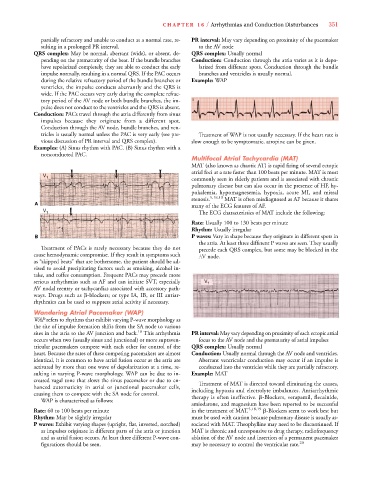
                                                                       Multifocal Atrial Tachycardia (MAT)
                                                                       MAT (also known as chaotic AT) is rapid firing of several ectopic
                                                                       atrial foci at a rate faster than 100 beats per minute. MAT is most
                      V 1
                                                                       commonly seen in elderly patients and is associated with chronic
                                                                       pulmonary disease but can also occur in the presence of HF, hy-
                                                                       pokalemia, hypomagnesemia, hypoxia, acute MI, and mitral
                                                                       stenosis. 5,18,19  MAT is often misdiagnosed as AF because it shares
                   A
                                                                       many of the ECG features of AF.
                      V 1                                                The ECG characteristics of MAT include the following:
                                                                       Rate: Usually 100 to 130 beats per minute
                                                                       Rhythm: Usually irregular
                   B                                                   P waves: Vary in shape because they originate in different spots in
                                                                         the atria. At least three different P waves are seen. They usually
                     Treatment of PACs is rarely necessary because they do not  precede each QRS complex, but some may be blocked in the
                   cause hemodynamic compromise. If they result in symptoms such  AV node.
                   as “skipped beats” that are bothersome, the patient should be ad-
                   vised to avoid precipitating factors such as smoking, alcohol in-
                   take, and coffee consumption. Frequent PACs may precede more
                   serious arrhythmias such as AF and can initiate SVT, especially  V 1
                   AV nodal reentry or tachycardias associated with accessory path-
                   ways. Drugs such as  -blockers; or type IA, IB, or III antiar-
                   rhythmics can be used to suppress atrial activity if necessary.
                   Wandering Atrial Pacemaker (WAP)
                   WAP refers to rhythms that exhibit varying P-wave morphology as
                   the site of impulse formation shifts from the SA node to various
                   sites in the atria to the AV junction and back. 18  This arrhythmia  PR interval: May vary depending on proximity of each ectopic atrial
                   occurs when two (usually sinus and junctional) or more supraven-  focus to the AV node and the prematurity of atrial impulses
                   tricular pacemakers compete with each other for control of the  QRS complex: Usually normal
                   heart. Because the rates of these competing pacemakers are almost  Conduction: Usually normal through the AV node and ventricles.
                   identical, it is common to have atrial fusion occur as the atria are  Aberrant ventricular conduction may occur if an impulse is
                   activated by more than one wave of depolarization at a time, re-  conducted into the ventricles while they are partially refractory.
                   sulting in varying P-wave morphology. WAP can be due to in-  Example: MAT
                   creased vagal tone that slows the sinus pacemaker or due to en-
                                                                         Treatment of MAT is directed toward eliminating the causes,
                   hanced automaticity in atrial or junctional pacemaker cells,
                                                                       including hypoxia and electrolyte imbalances. Antiarrhythmic
                   causing them to compete with the SA node for control.
                                                                       therapy is often ineffective.  -Blockers, verapamil, flecainide,
                     WAP is characterized as follows:
                                                                       amiodarone, and magnesium have been reported to be successful
                   Rate: 60 to 100 beats per minute                    in the treatment of MAT. 5,18,19   -Blockers seem to work best but
                   Rhythm: May be slightly irregular                   must be used with caution because pulmonary disease is usually as-
                   P waves: Exhibit varying shapes (upright, flat, inverted, notched)  sociated with MAT. Theophylline may need to be discontinued. If
                                                                                                          y
                                                                                                          y
                     as impulses originate in different parts of the atria or junction  MAT is chronic and unresponsive to drug therapy, radiofrequency
                     and as atrial fusion occurs. At least three different P-wave con-  ablation of the AV node and insertion of a permanent pacemaker
                     figurations should be seen.                        may be necessary to control the ventricular rate. 20

