


Page 374 - Cardiac Nursing
P. 374
1
                                   1
                                   2:1
                                /09
                                /09
                                    1
                                        M
                                        M
                                          Pa
                                   2:1
                                     6 A
                                     6 A
                          q
                          q
                           xd
                        87.
                        87.
                          q
                              /30
                              /30
                                /09
                           xd
                             6
                             6
                                          Pa
                                                  t
                                                  ara
                                                  ara
                                                 p
                                                 p
                                                  t
                                                     In
                                                      c.
                                                      c.
                                                   a
                                                   a
                                                     In
                                           g
                                            e 3
                                            e 3
                                          Pa
                                           g
                                           g
                                                A
                                                A
                                                 p
                                              50
                                              50
                                              50
                      3-3
                 16_
               0-c
                   p
                    33
                    33
         LWB
         LWB K34 0-c 16_ p pp333-387.qxd  6/30/09  12:16 AM  Page 350 Aptara Inc.
                      3-3
         LWBK340-c16_
            K34
                  350    P A R T  III / Assessment of Heart Disease
                   A
                   B
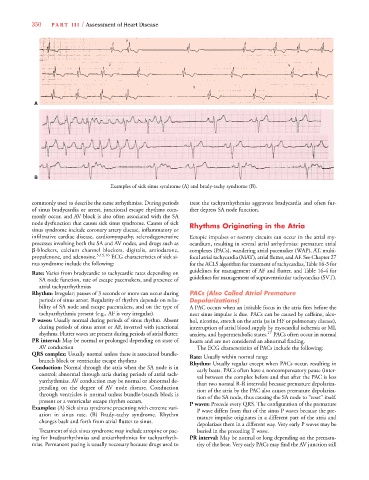
                                            Examples of sick sinus syndrome (A) and brady-tachy syndrome (B).
                  commonly used to describe the same arrhythmias. During periods  treat the tachyarrhythmias aggravate bradycardia and often fur-
                  of sinus bradycardia or arrest, junctional escape rhythms com-  ther depress SA node function.
                  monly occur, and AV block is also often associated with the SA
                  node dysfunction that causes sick sinus syndrome. Causes of sick  Rhythms Originating in the Atria
                  sinus syndrome include coronary artery disease, inflammatory or
                  infiltrative cardiac disease, cardiomyopathy, sclerodegenerative  Ectopic impulses or reentry circuits can occur in the atrial my-
                  processes involving both the SA and AV nodes, and drugs such as  ocardium, resulting in several atrial arrhythmias: premature atrial
                   -blockers, calcium channel blockers, digitalis, amiodarone,  complexes (PACs), wandering atrial pacemaker (WAP), AT, multi-
                  propafenone, and adenosine. 5,15,16  ECG characteristics of sick si-  focal atrial tachycardia (MAT), atrial flutter, and AF. See Chapter 27
                  nus syndrome include the following:                 for the ACLS algorithm for treatment of tachycardias, Table 16-3 for
                                                                      guidelines for management of AF and flutter, and Table 16-4 for
                  Rate: Varies from bradycardic to tachycardic rates depending on
                                                                      guidelines for management of supraventricular tachycardias (SVT).
                     SA node function, rate of escape pacemakers, and presence of
                     atrial tachyarrhythmias
                  Rhythm: Irregular; pauses of 3 seconds or more can occur during  PACs (Also Called Atrial Premature
                     periods of sinus arrest. Regularity of rhythm depends on relia-  Depolarizations)
                     bility of SA node and escape pacemakers, and on the type of  A PAC occurs when an irritable focus in the atria fires before the
                     tachyarrhythmia present (e.g., AF is very irregular).  next sinus impulse is due. PACs can be caused by caffeine, alco-
                  P waves: Usually normal during periods of sinus rhythm. Absent  hol, nicotine, stretch on the atria (as in HF or pulmonary disease),
                     during periods of sinus arrest or AF, inverted with junctional  interruption of atrial blood supply by myocardial ischemia or MI,
                     rhythms. Flutter waves are present during periods of atrial flutter.  anxiety, and hypermetabolic states. 17  PACs often occur in normal
                  PR interval: May be normal or prolonged depending on state of  hearts and are not considered an abnormal finding.
                     AV conduction                                      The ECG characteristics of PACs include the following:
                  QRS complex: Usually normal unless there is associated bundle-
                                                                      Rate: Usually within normal range
                     branch block or ventricular escape rhythms
                                                                      Rhythm: Usually regular except when PACs occur, resulting in
                  Conduction: Normal through the atria when the SA node is in
                                                                        early beats. PACs often have a noncompensatory pause (inter-
                     control; abnormal through atria during periods of atrial tach-
                                                                        val between the complex before and that after the PAC is less
                     yarrhythmias. AV conduction may be normal or abnormal de-
                                                                        than two normal R-R intervals) because premature depolariza-
                     pending on the degree of AV node disease. Conduction
                                                                        tion of the atria by the PAC also causes premature depolariza-
                     through ventricles is normal unless bundle-branch block is
                                                                        tion of the SA node, thus causing the SA node to “reset” itself.
                     present or a ventricular escape rhythm occurs.
                                                                      P waves: Precede every QRS. The configuration of the premature
                  Examples: (A) Sick sinus syndrome presenting with extreme vari-
                                                                        P wave differs from that of the sinus P waves because the pre-
                     ation in sinus rate. (B) Brady-tachy syndrome. Rhythm
                                                                        mature impulse originates in a different part of the atria and
                     changes back and forth from atrial flutter to sinus.
                                                                        depolarizes them in a different way. Very early P waves may be
                     Treatment of sick sinus syndrome may include atropine or pac-  buried in the preceding T wave.
                  ing for bradyarrhythmias and antiarrhythmics for tachyarrhyth-  PR interval: May be normal or long depending on the prematu-
                  mias. Permanent pacing is usually necessary because drugs used to  rity of the beat. Very early PACs may find the AV junction still

