


Page 373 - Cardiac Nursing
P. 373
1
                                   1
                                   1
                                /09
                                /09
                                /09
                                     6 A
                                        M
                                        M
                                   2:1
                                   2:1
                                     6 A
                              /30
                        87.
                          q
                          q
                      3-3
                      3-3
                        87.
                             6
                             6
                              /30
                          q
                           xd
                           xd
                                          Pa
                                                  t
                                                  ara
                                                  ara
                                                 p
                                                 p
                                                  t
                                                     In
                                                      c.
                                                      c.
                                                   a
                                                   a
                                                     In
                                                 p
                                           g
                                           g
                                            e 3
                                          Pa
                                          Pa
                                           g
                                              49
                                                A
                                                A
                                            e 3
                                              49
                                              49
                   p
         LWB
         LWB
                    33
                    33
         LWBK340-c16_ p pp333-387.qxd  6/30/09  12:16 AM  Page 349 Aptara Inc.
               0-c
                 16_
                 16_
            K34
            K34
               0-c
                                                             C HAPTER 1 6 / Arrhythmias and Conduction Disturbances  349
                                                V V 1
                                             A
                         B
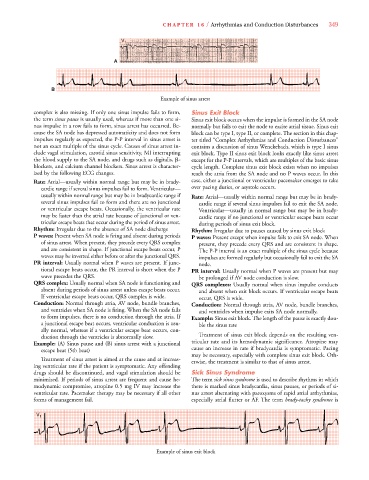
                                                             Example of sinus arrest
                   complex is also missing. If only one sinus impulse fails to form,  Sinus Exit Block
                   the term sinus pause is usually used, whereas if more than one si-  Sinus exit block occurs when the impulse is formed in the SA node
                   nus impulse in a row fails to form, sinus arrest has occurred. Be-  normally but fails to exit the node to excite atrial tissue. Sinus exit
                   cause the SA node has depressed automaticity and does not form  block can be type I, type II, or complete. The section in this chap-
                   impulses regularly as expected, the P-P interval in sinus arrest is  ter titled “Complex Arrhythmias and Conduction Disturbances”
                   not an exact multiple of the sinus cycle. Causes of sinus arrest in-  contains a discussion of sinus Wenckebach, which is type I sinus
                   clude vagal stimulation, carotid sinus sensitivity, MI interrupting  exit block. Type II sinus exit block looks exactly like sinus arrest
                   the blood supply to the SA node, and drugs such as digitalis,  -  except for the P-P intervals, which are multiples of the basic sinus
                   blockers, and calcium channel blockers. Sinus arrest is character-  cycle length. Complete sinus exit block exists when no impulses
                   ized by the following ECG changes.                  reach the atria from the SA node and no P waves occur. In this
                   Rate: Atrial—usually within normal range but may be in brady-  case, either a junctional or ventricular pacemaker emerges to take
                     cardic range if several sinus impulses fail to form. Ventricular—  over pacing duties, or asystole occurs.
                     usually within normal range but may be in bradycardic range if  Rate: Atrial—usually within normal range but may be in brady-
                     several sinus impulses fail to form and there are no junctional  cardic range if several sinus impulses fail to exit the SA node.
                     or ventricular escape beats. Occasionally, the ventricular rate  Ventricular—usually in normal range but may be in brady-
                     may be faster than the atrial rate because of junctional or ven-  cardic range if no junctional or ventricular escape beats occur
                     tricular escape beats that occur during the period of sinus arrest.  during periods of sinus exit block.
                   Rhythm: Irregular due to the absence of SA node discharge  Rhythm: Irregular due to pauses caused by sinus exit block
                   P waves: Present when SA node is firing and absent during periods  P waves: Present except when impulse fails to exit SA node. When
                     of sinus arrest. When present, they precede every QRS complex  present, they precede every QRS and are consistent in shape.
                     and are consistent in shape. If junctional escape beats occur, P  The P-P interval is an exact multiple of the sinus cycle because
                     waves may be inverted either before or after the junctional QRS.  impulses are formed regularly but occasionally fail to exit the SA
                   PR interval: Usually normal when P waves are present. If junc-  node.
                     tional escape beats occur, the PR interval is short when the P  PR interval: Usually normal when P waves are present but may
                     wave precedes the QRS.                              be prolonged if AV node conduction is slow.
                   QRS complex: Usually normal when SA node is functioning and  QRS complexes: Usually normal when sinus impulse conducts
                     absent during periods of sinus arrest unless escape beats occur.  and absent when exit block occurs. If ventricular escape beats
                     If ventricular escape beats occur, QRS complex is wide.  occur, QRS is wide.
                   Conduction: Normal through atria, AV node, bundle branches,  Conduction: Normal through atria, AV node, bundle branches,
                     and ventricles when SA node is firing. When the SA node fails  and ventricles when impulse exits SA node normally.
                     to form impulses, there is no conduction through the atria. If  Example: Sinus exit block. The length of the pause is exactly dou-
                     a junctional escape beat occurs, ventricular conduction is usu-  ble the sinus rate
                     ally normal, whereas if a ventricular escape beat occurs, con-
                     duction through the ventricles is abnormally slow.  Treatment of sinus exit block depends on the resulting ven-
                   Example: (A) Sinus pause and (B) sinus arrest with a junctional  tricular rate and its hemodynamic significance. Atropine may
                     escape beat (5th beat)                            cause an increase in rate if bradycardia is symptomatic. Pacing
                                                                       may be necessary, especially with complete sinus exit block. Oth-
                     Treatment of sinus arrest is aimed at the cause and at increas-  erwise, the treatment is similar to that of sinus arrest.
                   ing ventricular rate if the patient is symptomatic. Any offending
                   drugs should be discontinued, and vagal stimulation should be  Sick Sinus Syndrome
                   minimized. If periods of sinus arrest are frequent and cause he-  The term sick sinus syndrome is used to describe rhythms in which
                   modynamic compromise, atropine 0.5 mg IV may increase the  there is marked sinus bradycardia, sinus pauses, or periods of si-
                   ventricular rate. Pacemaker therapy may be necessary if all other  nus arrest alternating with paroxysms of rapid atrial arrhythmias,
                   forms of management fail.                           especially atrial flutter or AF. The term brady-tachy syndrome is
                    V V 1 1
                                                           Example of sinus exit block

