


Page 380 - Cardiac Nursing
P. 380
3-3
                        87.
                      3-3
                                           g
                                           g
                          q
                           xd
                          q
                        87.
                          q
                                            e 3
                                                 p
                                                A
                                                 p
                                                  t
                                                 p
                                              56
                                            e 3
                                              56
                                                A
                                              56
                                     6 A
                                        M
                                     6 A
                                   2:1
                                   2:1
                                          Pa
                                           g
                                          Pa
                                        M
                                          Pa
                                   1
                              /30
                              /30
                             6
                           xd
                             6
                                    1
                                   1
                                /09
                                /09
                                /09
                                                  t
         LWB
         LWB
         LWBK340-c16_ pp333-387.qxd  6/30/09  12:16 AM  Page 356 Aptara Inc.
                                                      c.
                                                      c.
                 16_
            K34
            K34
               0-c
                 16_
               0-c
                                                     In
                                                   a
                                                  ara
                   p
                   p
                    33
                    33
                                                  ara
                                                   a
                                                     In
                  356    P A R T  III / Assessment of Heart Disease
                   A
                   B
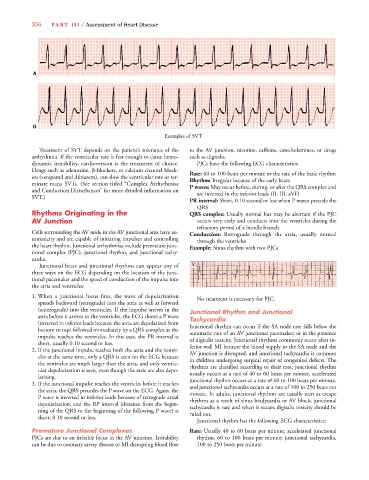
                                                              Examples of SVT
                     Treatment of SVT depends on the patient’s tolerance of the  to the AV junction, nicotine, caffeine, catecholamines, or drugs
                  arrhythmia. If the ventricular rate is fast enough to cause hemo-  such as digitalis.
                  dynamic instability, cardioversion is the treatment of choice.  PJCs have the following ECG characteristics:
                  Drugs such as adenosine,  -blockers, or calcium channel block-  Rate: 60 to 100 beats per minute or the rate of the basic rhythm
                  ers (verapamil and diltiazem), can slow the ventricular rate or ter-  Rhythm: Irregular because of the early beats
                  minate many SVTs. (See section titled “Complex Arrhythmias  P waves: May occur before, during, or after the QRS complex and
                  and Conduction Disturbances” for more detailed information on  are inverted in the inferior leads (II, III, aVF)
                  SVT.)
                                                                      PR interval: Short, 0.10 second or less when P waves precede the
                                                                        QRS
                  Rhythms Originating in the                          QRS complex: Usually normal but may be aberrant if the PJC
                  AV Junction                                           occurs very early and conducts into the ventricles during the
                                                                        refractory period of a bundle branch
                  Cells surrounding the AV node in the AV junctional area have au-  Conduction: Retrograde through the atria, usually normal
                  tomaticity and are capable of initiating impulses and controlling  through the ventricles
                  the heart rhythm. Junctional arrhythmias include premature junc-  Example: Sinus rhythm with two PJCs
                  tional complex (PJC), junctional rhythm, and junctional tachy-
                  cardia.
                     Junctional beats and junctional rhythms can appear any of  V 1
                  three ways on the ECG depending on the location of the junc-
                  tional pacemaker and the speed of conduction of the impulse into
                  the atria and ventricles:
                  1. When a junctional  focus  fires, the wave of  depolarization  No treatment is necessary for PJC.
                    spreads backward (retrograde) into the atria as well as forward
                    (anterograde) into the ventricles. If the impulse arrives in the  Junctional Rhythm and Junctional
                    atria before it arrives in the ventricles, the ECG shows a P wave  Tachycardia
                    (inverted in inferior leads because the atria are depolarized from  Junctional rhythm can occur if the SA node rate falls below the
                    bottom to top) followed immediately by a QRS complex as the  automatic rate of an AV junctional pacemaker, or in the presence
                    impulse reaches the ventricles. In this case, the PR interval is  of digitalis toxicity. Junctional rhythms commonly occur after in-
                    short, usually 0.10 second or less.               ferior wall MI because the blood supply to the SA node and the
                  2. If the junctional impulse reaches both the atria and the ventri-  AV junction is disrupted, and junctional tachycardia is common
                    cles at the same time, only a QRS is seen on the ECG because  in children undergoing surgical repair of congenital defects. The
                    the ventricles are much larger than the atria, and only ventric-  rhythms are classified according to their rate; junctional rhythm
                    ular depolarization is seen, even though the atria are also depo-  usually occurs at a rate of 40 to 60 beats per minute, accelerated
                    larizing.                                         junctional rhythm occurs at a rate of 60 to 100 beats per minute,
                  3. If the junctional impulse reaches the ventricles before it reaches  and junctional tachycardia occurs at a rate of 100 to 250 beats per
                    the atria, the QRS precedes the P wave on the ECG. Again, the  minute. In adults, junctional rhythms are usually seen as escape
                    P wave is inverted in inferior leads because of retrograde atrial  rhythms as a result of sinus bradycardia or AV block; junctional
                    depolarization, and the RP interval (distance from the begin-  tachycardia is rare and when it occurs digitalis toxicity should be
                    ning of the QRS to the beginning of the following P wave) is  ruled out.
                    short, 0.10 second or less.
                                                                        Junctional rhythm has the following ECG characteristics:
                  Premature Junctional Complexes                      Rate: Usually 40 to 60 beats per minute; accelerated junctional
                  PJCs are due to an irritable focus in the AV junction. Irritability  rhythm, 60 to 100 beats per minute; junctional tachycardia,
                  can be due to coronary artery disease or MI disrupting blood flow  100 to 250 beats per minute

