


Page 384 - Cardiac Nursing
P. 384
1
                                   1
                                   2:1
                              /30
                                /09
                                /09
                                        M
                                        M
                                          Pa
                                   2:1
                                     6 A
                                     6 A
                              /30
                        87.
                          q
                          q
                      3-3
                      3-3
                        87.
                              6
                             6
                             6
                          q
                           xd
                           xd
                                                  ara
                                                  ara
                                                   a
                                                 p
                                                  t
                                                  t
                                                      c.
                                                      c.
                                                      c.
                                                   a
                                                     In
                                                     In
                                                 p
                                           g
                                            e 3
                                            e 3
                                          Pa
                                           g
                                           g
                                                A
                                                A
                                                 p
                                              60
                                              60
                                                A
         LWBK340-c16_
                    33
            K34
                 16_
               0-c
         LWB
         LWB K34 0-c 16_ p p pp333-387.qxd  6/30/09  12:16 AM  Page 360 Aptara Inc.
                    33
                  360    P A R T  III / Assessment of Heart Disease
                     VF requires immediate defibrillation. Synchronized cardiover-  CPR must be initiated immediately if the patient is to survive.
                  sion is not possible because there are no formed QRS complexes  IV epinephrine and atropine may be given in an effort to stimu-
                  on which to synchronize the shock. CPR must be performed if a  late a rhythm; vasopressin can be used instead of epinephrine as a
                  defibrillator is not immediately available. The American Heart As-  vasopressor. Asystole has a very poor prognosis despite the best re-
                  sociation guidelines for VF and pulseless VT call for CPR until a  suscitation efforts because it usually represents extensive myocar-
                  defibrillator is available, then immediate defibrillation using and  dial ischemia or severe underlying metabolic problems. See Chap-
                  automatic external defibrillator; or manual defibrillation with 360 J  ter 27 for the ACLS algorithm for treatment of asystole.
                  if using a monophasic defibrillator or device-specific energy rec-
                  ommendation (200 J if this is not known) if using a biphasic de-  Conduction Abnormalities
                  fibrillator. 53  Immediate CPR for 2 minutes is recommended fol-
                  lowing the first shock. See Chapter 27 for more information on  The term AV block is used to describe arrhythmias in which there
                  management of cardiac arrest.                       is delayed or failed conduction of supraventricular impulses into
                     Amiodarone is the drug recommended for antiarrhythmic  the ventricles. AV blocks have been classified according to location
                  therapy in VF following defibrillation. Lidocaine is an alternative  of the block and severity of the conduction abnormality. The fol-
                  (but not the preferred drug) according to the ACLS manual and  lowing classification of AV blocks is discussed in this section:
                  is still used clinically in many hospitals. Drugs have not been
                  shown to improve survival in patients with recurrent hemody-  First-degree AV block
                  namically unstable ventricular arrhythmias; even amiodarone,  Second-degree AV block
                  which is the most effective antiarrhythmic, is inferior to ICD in  Type I
                  reducing the incidence of SCD. However, amiodarone and  -  Type II
                  blockers, often in combination, are used in patients with recurrent  2:1 conduction (can be type I or type II)
                  ventricular arrhythmias who are not eligible for ICD implantation  High-grade AV block (or advanced AV block)
                  or in those who have an ICD but have recurrent ventricular ar-  Third-degree AV block
                  rhythmias that cause frequent ICD shocks. Sotalol is also effective  AV block can be caused by disease processes that either inter-
                  in suppressing ventricular arrhythmias in many patients.  rupt the blood supply to structures in the conduction system or
                                                                      otherwise interfere with the function of these structures, or by
                  Ventricular Asystole                                drugs that slow conduction through the AV node. It can also oc-
                  Ventricular asystole is the absence of any ventricular rhythm; there  cur in normal hearts and be a result of normal physiologic varia-
                  is no QRS complex, no pulse, and no cardiac output. The term  tions (e.g., vagal tone) that affect conduction through the AV
                  “ventricular standstill” is sometimes used when atrial activity is  node, or in athletes or people who exercise regularly; it can occur
                  still present but no ventricular activity occurs. Both situations are  during sleep when sympathetic tone is reduced or vagal tone is en-
                  fatal unless treated immediately. Ventricular asystole has the fol-  hanced. One of the main functions of the AV node is to block
                  lowing characteristics:                             rapid atrial impulses to prevent dangerously fast ventricular rates in
                  Rate: None                                          response to rapid atrial rhythms such as rapid AT, atrial flutter, or
                  Rhythm: None                                        AF. In this case, the block is physiologic and must not be confused
                  P waves: May be present if the SA node is functioning  with pathologic block due to abnormal AV node function. For ex-
                  PR interval: None                                   ample, a sinus rate of 80 should be conducted through a normally
                  QRS complex: None                                   functioning AV conduction system in a 1:1 fashion, so, if any of
                  Conduction: Atrial conduction may be normal if the SA node is  those sinus impulses are blocked, that is abnormal AV node func-
                     functioning. There is no conduction into the ventricles.  tion and the term block appropriately applies. However, atrial flut-
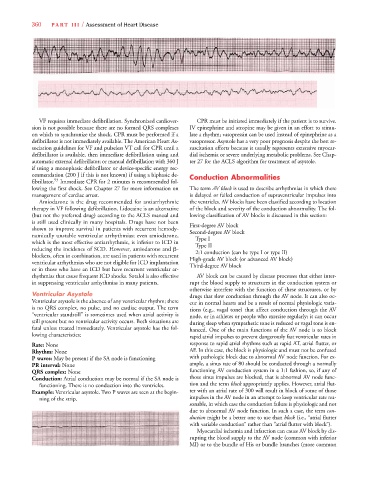
                  Example: Ventricular asystole. Two P waves are seen at the begin-  ter with an atrial rate of 300 will result in block of some of those
                     ning of the strip.                               impulses in the AV node in an attempt to keep ventricular rate rea-
                                                                      sonable, in which case the conduction failure is physiologic and not
                                                                      due to abnormal AV node function. In such a case, the term con-
                                                                      duction might be a better one to use than block (i.e., “atrial flutter
                                                                      with variable conduction” rather than “atrial flutter with block”).
                                                                        Myocardial ischemia and infarction can cause AV block by dis-
                                                                      rupting the blood supply to the AV node (common with inferior
                                                                      MI) or to the bundle of His or bundle branches (more common

