


Page 381 - Cardiac Nursing
P. 381
1
                                   1
                                   1
                                /09
                                /09
                                /09
                                     6 A
                                        M
                                        M
                                   2:1
                                   2:1
                                     6 A
                              /30
                        87.
                          q
                          q
                      3-3
                      3-3
                        87.
                             6
                             6
                              /30
                          q
                           xd
                           xd
                                          Pa
                                                  t
                                                  ara
                                                  ara
                                                 p
                                                 p
                                                  t
                                                     In
                                                      c.
                                                      c.
                                                   a
                                                   a
                                                     In
                                                 p
                                           g
                                           g
                                            e 3
                                          Pa
                                          Pa
                                           g
                                              57
                                                A
                                                A
                                            e 3
                                              57
                                              57
            K34
         LWBK340-c16_
                 16_
               0-c
                    33
         LWB K34 0-c 16_ p p pp333-387.qxd  6/30/09  12:16 AM  Page 357 Aptara Inc.
         LWB
                    33
                                                             C HAPTER 1 6 / Arrhythmias and Conduction Disturbances  357
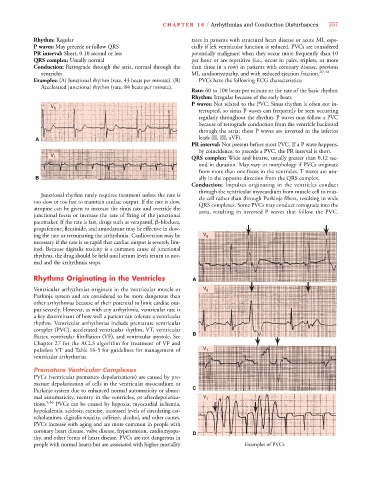
                   Rhythm: Regular                                     rates in patients with structural heart disease or acute MI, espe-
                   P waves: May precede or follow QRS                  cially if left ventricular function is reduced. PVCs are considered
                   PR interval: Short, 0.10 second or less             potentially malignant when they occur more frequently than 10
                   QRS complex: Usually normal                         per hour or are repetitive (i.e., occur in pairs, triplets, or more
                   Conduction: Retrograde through the atria, normal through the  than three in a row) in patients with coronary disease, previous
                     ventricles                                        MI, cardiomyopathy, and with reduced ejection fraction. 47,48
                   Examples: (A) Junctional rhythm (rate, 43 beats per minute). (B)  PVCs have the following ECG characteristics:
                     Accelerated junctional rhythm (rate, 84 beats per minute).
                                                                       Rate: 60 to 100 beats per minute or the rate of the basic rhythm
                                                                       Rhythm: Irregular because of the early beats
                                                                       P waves: Not related to the PVC. Sinus rhythm is often not in-
                         V 6
                                                                         terrupted, so sinus P waves can frequently be seen occurring
                                                                         regularly throughout the rhythm. P waves may follow a PVC
                                                                         because of retrograde conduction from the ventricle backward
                                                                         through the atria; these P waves are inverted in the inferior
                    A                                                    leads (II, III, aVF).
                                                                       PR interval: Not present before most PVC. If a P wave happens,
                                                                         by coincidence, to precede a PVC, the PR interval is short.
                         V 1                                           QRS complex: Wide and bizarre, usually greater than 0.12 sec-
                                                                         ond in duration. May vary in morphology if PVCs originate
                                                                         from more than one focus in the ventricles. T waves are usu-
                    B                                                    ally in the opposite direction from the QRS complex.
                                                                       Conduction: Impulses originating in the ventricles conduct
                                                                         through the ventricular myocardium from muscle cell to mus-
                     Junctional rhythm rarely requires treatment unless the rate is  cle cell rather than through Purkinje fibers, resulting in wide
                   too slow or too fast to maintain cardiac output. If the rate is slow,  QRS complexes. Some PVCs may conduct retrograde into the
                   atropine can be given to increase the sinus rate and override the  atria, resulting in inverted P waves that follow the PVC.
                   junctional focus or increase the rate of firing of the junctional
                   pacemaker. If the rate is fast, drugs such as verapamil,  -blockers,
                   propafenone, flecainide, and amiodarone may be effective in slow-
                   ing the rate or terminating the arrhythmia. Cardioversion may be  V 6
                   necessary if the rate is so rapid that cardiac output is severely lim-
                   ited. Because digitalis toxicity is a common cause of junctional
                   rhythms, the drug should be held until serum levels return to nor-
                   mal and the arrhythmia stops.
                   Rhythms Originating in the Ventricles               A A
                   Ventricular arrhythmias originate in the ventricular muscle or  V 6
                   Purkinje system and are considered to be more dangerous than
                   other arrhythmias because of their potential to limit cardiac out-
                   put severely. However, as with any arrhythmia, ventricular rate is
                   a key determinant of how well a patient can tolerate a ventricular
                   rhythm. Ventricular arrhythmias include premature ventricular
                   complex (PVC), accelerated ventricular rhythm, VT, ventricular
                   flutter, ventricular fibrillation (VF), and ventricular asystole. See  B B
                   Chapter 27 for the ACLS algorithm for treatment of VF and
                   pulseless VT and Table 16-5 for guidelines for management of  V 1
                   ventricular arrhythmias.
                   Premature Ventricular Complexes
                   PVCs (ventricular premature depolarizations) are caused by pre-
                   mature depolarization of cells in the ventricular myocardium or
                   Purkinje system due to enhanced normal automaticity or abnor-  C C
                   mal automaticity, reentry in the ventricles, or afterdepolariza-  V 1
                   tions. 5,46  PVCs can be caused by hypoxia, myocardial ischemia,
                   hypokalemia, acidosis, exercise, increased levels of circulating cat-
                   echolamines, digitalis toxicity, caffeine, alcohol, and other causes.
                   PVCs increase with aging and are more common in people with
                   coronary heart disease, valve disease, hypertension, cardiomyopa-  D D
                   thy, and other forms of heart disease. PVCs are not dangerous in
                   people with normal hearts but are associated with higher mortality   Examples of PVCs

