


Page 382 - Cardiac Nursing
P. 382
1
                                   1
                                   1
                                /09
                                /09
                                /09
                                     6 A
                                        M
                                        M
                                   2:1
                                   2:1
                                     6 A
                              /30
                        87.
                          q
                          q
                      3-3
                      3-3
                        87.
                             6
                             6
                              /30
                          q
                           xd
                           xd
                                          Pa
                                                  t
                                                  ara
                                                  ara
                                                 p
                                                 p
                                                  t
                                                     In
                                                      c.
                                                      c.
                                                   a
                                                   a
                                                     In
                                                 p
                                           g
                                           g
                                            e 3
                                          Pa
                                          Pa
                                           g
                                              58
                                                A
                                                A
                                            e 3
                                              58
                                              58
                    33
                   p
         LWB
                    33
               0-c
                 16_
                   p
            K34
         LWBK340-c16_
         LWB K34 0-c 16_ pp333-387.qxd  6/30/09  12:16 AM  Page 358 Aptara Inc.
                  358    P A R T  III / Assessment of Heart Disease
                     When the sinus rhythm is undisturbed by PVCs, the atria de-  The treatment of accelerated ventricular rhythm depends on
                     polarize normally.                               its cause and how well it is tolerated by the patient. This arrhyth-
                  Examples: (A) Normal sinus rhythm with a PVC. (B) Sinus  mia alone is usually not harmful because the ventricular rate is
                     rhythm with multifocal PVC. (C) Paired PVC. (D) R-on-T  within normal limits and usually adequate to maintain cardiac
                     PVC, resulting in short runs of VT.              output. If the patient is symptomatic because of the loss of atrial
                                                                      kick during long episodes of AV dissociation, atropine can be used
                     The significance of PVCs depends on the clinical setting in
                                                                      to increase the rate of the SA node and overdrive the ventricular
                  which they occur. Many people have chronic PVCs that do not
                                                                      rhythm. Suppressive therapy is rarely used because abolishing the
                  need to be treated, and most of these people are asymptomatic.
                                                                      ventricular rhythm may leave an even less desirable heart rate.
                  There is no evidence that suppression of PVCs reduces mortality,
                                                                      Usually, accelerated ventricular rhythm is transient and benign
                  especially in patients with no structural heart disease. If PVCs
                                                                      and does not require treatment.
                  cause bothersome palpitations, patients should be told to avoid
                  caffeine, tobacco, other stimulants, and try stress reduction tech-  Ventricular Tachycardia
                  niques. Low-dose  -blockers may reduce PVC frequency and the  VT is a rapid ventricular rhythm most likely due to reentry in the
                  perception of palpitations and can be used for symptom relief. In  ventricles, although automaticity of an ectopic focus and afterde-
                  the setting of an acute MI or myocardial ischemia, PVCs may be  polarizations may also be mechanisms of VT. 5,22  VT can be clas-
                  precursors of more dangerous ventricular arrhythmias, especially  sified according to (1) duration—nonsustained (lasts  30 sec-
                  when they occur near the apex of the T wave (R-on-T PVC). Pro-  onds), sustained (lasts  30 seconds), incessant (VT present most
                  phylactic treatment of asymptomatic nonsustained ventricular ar-  of the time); (2) morphology (ECG appearance of QRS com-
                  rhythmias is not recommended. 49                    plexes)—monomorphic (QRS complexes have the same shape dur-
                                                                      ing tachycardia), polymorphic (QRS complexes vary randomly in
                  Accelerated Idioventricular Rhythm                  shape), bidirectional (alternating upright and negative QRS com-
                  Accelerated idioventricular rhythm occurs when an ectopic focus  plexes during tachycardia). The terms salvos and bursts are often
                  in the ventricles fires at a rate of 50 to 100 beats per minute. Ac-  used to describe short runs of VT (i.e., 5 to 10 or more beats in a
                  celerated idioventricular rhythm commonly occurs in the pres-  row). See section titled “Complex Arrhythmias and Conduction
                  ence of inferior MI and during reperfusion with thrombolytic  Disturbances” later in this chapter for more information on
                  therapy, when the rate of the SA node slows below the rate of the  monomorphic and PVT.
                  latent ventricular pacemaker. (See section titled “Complex Ar-  The most common cause of VT is CHD, including acute is-
                  rhythmias and Conduction Disturbances” for a discussion of AV  chemia and MI, prior MI, and chronic coronary disease. The next
                  dissociation.) The ECG characteristics of accelerated ventricular  most common cause is cardiomyopathy, both dilated and hyper-
                  rhythm include the following:                       trophic. Other causes include valvular heart disease, congenital
                                                                      heart disease, arrhythmogenic right ventricular dysplasia, inher-
                  Rate: 50 to 100 beats per minute
                  Rhythm: Usually regular                             ited ion channel abnormalities, cardiac surgery, and the proar-
                                                                                              22,48,50,51
                  P waves: May be seen but are dissociated from the QRS. If retro-  rhythmic effects of many drugs.  VT that occurs in the
                     grade conduction from the ventricle to the atria occurs, P  presence of left ventricular dysfunction and reduced ejection frac-
                     waves follow the QRS complex.                    tion is associated with a higher incidence of adverse cardiac events,
                  PR interval: Not present                            including an increased risk of SCD.
                  QRS complex: Wide and bizarre                         Idiopathic VT is VT that occurs in patients with no known
                                                                                        22,48,52
                  Conduction: If sinus rhythm is the basic rhythm, atrial conduc-  structural heart disease.  This type of VT is discussed in
                     tion is normal. Impulses originating in the ventricles conduct  more detail later in the section titled “Complex Arrhythmias and
                     through the ventricular myocardium by cell-to-cell conduc-  Conduction Disturbances”.
                     tion, resulting in the wide QRS complex.           ECG characteristics of monomorphic VT include the follow-
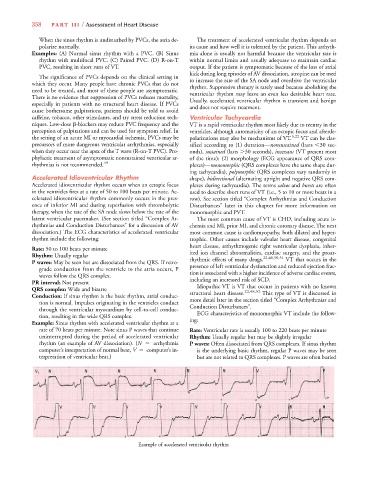
                  Example: Sinus rhythm with accelerated ventricular rhythm at a  ing:
                     rate of 70 beats per minute. Note sinus P waves that continue  Rate: Ventricular rate is usually 100 to 220 beats per minute
                     uninterrupted during the period of accelerated ventricular  Rhythm: Usually regular but may be slightly irregular
                     rhythm (an example of AV dissociation). (N   arrhythmia  P waves: Often dissociated from QRS complexes. If sinus rhythm
                     computer’s interpretation of normal beat, V   computer’s in-  is the underlying basic rhythm, regular P waves may be seen
                     terpretation of ventricular beat.)                 but are not related to QRS complexes. P waves are often buried
                                                     Example of accelerated ventricular rhythm

