


Page 383 - Cardiac Nursing
P. 383
1
                                   1
                                   2:1
                                /09
                                /09
                                    1
                                        M
                                        M
                                          Pa
                                   2:1
                                     6 A
                                     6 A
                                /09
                          q
                          q
                          q
                      3-3
                        87.
                        87.
                             6
                              /30
                              /30
                           xd
                           xd
                             6
                                                  t
                                                  ara
                                                  ara
                                                 p
                                                 p
                                                  t
                                                     In
                                                      c.
                                                      c.
                                                   a
                                                   a
                                                     In
                                                 p
                                           g
                                           g
                                            e 3
                                          Pa
                                          Pa
                                           g
                                              59
                                                A
                                                A
                                            e 3
                                              59
                                              59
                      3-3
         LWB
         LWBK340-c16_
                    33
                    33
            K34
         LWB K34 0-c 16_ p p pp333-387.qxd  6/30/09  12:16 AM  Page 359 Aptara Inc.
                 16_
               0-c
                                                             C HAPTER 1 6 / Arrhythmias and Conduction Disturbances  359
                     in QRS complexes or T waves. VT may conduct retrograde to  that is refractory to cardioversion or recurrent despite pro-
                     the atria with P waves visible after each QRS.    cainamide. 49  Lidocaine is reasonable for the initial treatment of
                   PR interval: Not measurable because of dissociation of P waves  stable sustained monomorphic VT associated with acute myocar-
                     from QRS complexes                                dial ischemia or infarction. 49
                   QRS complex: Wide and bizarre, greater than 0.12 second in du-  Long-term drug therapy for ventricular arrhythmias includes
                     ration                                             -blockers because they are effective in suppressing ventricular ar-
                   Conduction: Impulse originates in one ventricle and spreads by  rhythmias and reducing SCD in patients post-MI, those with HF,
                     muscle cell-to-cell conduction through  both ventricles.  and cardiomyopathy. Amiodarone and sotalol are effective in sup-
                     There may be retrograde conduction through the atria, but  pressing ventricular arrhythmias but most studies show no long-
                     often the SA node continues to fire regularly and depolarizes  term survival benefit. Nonpharmacologic therapy for recurrent
                     the atria normally. Rarely, one of these sinus impulses may  VT includes radiofrequency catheter ablation and the implantable
                     conduct normally through the AV node and into the ventri-  cardioverter defibrillator (ICD) (see Chapters 18 and 28).
                     cle before the next ectopic ventricular impulse fires, result-
                     ing in a normal QRS complex, called a capture beat. Occa-  Ventricular Flutter
                     sionally, a fusion  beat may occur as the ventricles are  Ventricular flutter is similar to VT, but the rate is faster. Hemo-
                     depolarized by a descending sinus impulse and the ventricu-  dynamically, ventricular flutter is more dangerous because there is
                     lar ectopic impulse simultaneously, resulting in a QRS com-  virtually no cardiac output. ECG characteristics of ventricular
                     plex that looks different from both the normal beats and the  flutter are as follows:
                     ventricular beats.                                Rate: Ventricular rate is usually 220 to 400 beats per minute
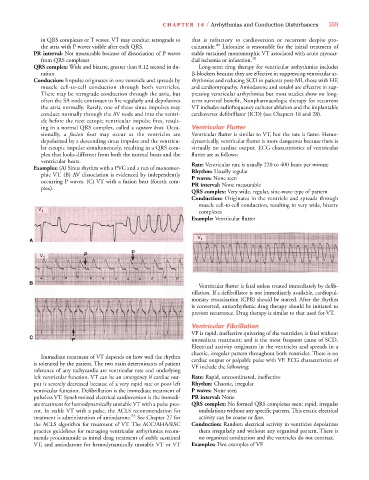
                   Examples: (A) Sinus rhythm with a PVC and a run of monomor-  Rhythm: Usually regular
                     phic VT. (B) AV dissociation is evidenced by independently  P waves: None seen
                     occurring P waves. (C) VT with a fusion beat (fourth com-  PR interval: None measurable
                     plex).
                                                                       QRS complex: Very wide, regular, sine-wave type of pattern
                                                                       Conduction: Originates in the ventricle and spreads through
                                                                         muscle cell-to-cell conduction, resulting in very wide, bizarre
                    V 1                                                  complexes
                                                                       Example: Ventricular flutter
                                                                         V
                  A                                                       1
                     V 1
                  B
                                                                         Ventricular flutter is fatal unless treated immediately by defib-
                                                                       rillation. If a defibrillator is not immediately available, cardiopul-
                                                                       monary resuscitation (CPR) should be started. After the rhythm
                                                                       is converted, antiarrhythmic drug therapy should be initiated to
                                                                       prevent recurrence. Drug therapy is similar to that used for VT.
                                                                       Ventricular Fibrillation
                                                                       VF is rapid, ineffective quivering of the ventricles; is fatal without
                  C
                                                                       immediate treatment; and is the most frequent cause of SCD.
                                                                       Electrical activity originates in the ventricles and spreads in a
                                                                       chaotic, irregular pattern throughout both ventricles. There is no
                     Immediate treatment of VT depends on how well the rhythm  cardiac output or palpable pulse with VF. ECG characteristics of
                   is tolerated by the patient. The two main determinants of patient  VF include the following:
                   tolerance of any tachycardia are ventricular rate and underlying
                   left ventricular function. VT can be an emergency if cardiac out-  Rate: Rapid, uncoordinated, ineffective
                   put is severely decreased because of a very rapid rate or poor left  Rhythm: Chaotic, irregular
                   ventricular function. Defibrillation is the immediate treatment of  P waves: None seen
                   pulseless VT. Synchronized electrical cardioversion is the immedi-  PR interval: None
                   ate treatment for hemodynamically unstable VT with a pulse pres-  QRS complex: No formed QRS complexes seen; rapid, irregular
                   ent. In stable VT with a pulse, the ACLS recommendation for  undulations without any specific pattern. This erratic electrical
                   treatment is administration of amiodarone. 53  See Chapter 27 for  activity can be coarse or fine.
                   the ACLS algorithm for treatment of VT. The ACC/AHA/ESC  Conduction: Random electrical activity in ventricles depolarizes
                   practice guidelines for managing ventricular arrhythmias recom-  them irregularly and without any organized pattern. There is
                   mends procainamide as initial drug treatment of stable sustained  no organized conduction and the ventricles do not contract.
                   VT, and amiodarone for hemodynamically unstable VT or VT  Examples: Two examples of VF

