


Page 385 - Cardiac Nursing
P. 385
1
                                   1
                                   1
                                /09
                                /09
                                /09
                                     6 A
                                        M
                                        M
                                   2:1
                                   2:1
                                     6 A
                              /30
                        87.
                          q
                          q
                      3-3
                      3-3
                        87.
                             6
                             6
                              /30
                          q
                           xd
                           xd
                                          Pa
                                                  t
                                                  ara
                                                  ara
                                                 p
                                                 p
                                                  t
                                                     In
                                                      c.
                                                      c.
                                                   a
                                                   a
                                                     In
                                                 p
                                           g
                                           g
                                            e 3
                                          Pa
                                          Pa
                                           g
                                              61
                                                A
                                                A
                                            e 3
                                              61
                                              61
                 16_
               0-c
                    33
                    33
            K34
         LWB K34 0-c 16_ p p pp333-387.qxd  6/30/09  12:16 AM  Page 361 Aptara Inc.
         LWB
         LWBK340-c16_
                                                             C HAPTER 1 6 / Arrhythmias and Conduction Disturbances  361
                   with anterior MI). Rheumatic heart disease, inflammatory dis-  Rate: Can occur at any sinus or atrial rate
                   eases, infectious diseases (Lyme disease, endocarditis, myocardi-  Rhythm: Irregular unless 2:1 conduction is present. Overall ap-
                   tis), collagen diseases, idiopathic fibrosis of the conduction system  pearance of the rhythm  demonstrates group  beating (i.e.,
                   (Lev’s disease or Lenègre’s disease), valve disease (usually aortic or  groups of beats separated by pauses).
                   mitral), atrial septal defects, congenital heart disease, and infiltra-  P waves: Normal. Some P waves are not conducted to the ventri-
                   tive cardiomyopathies (amyloidosis, sarcoidosis) can all cause  cles, but only one at a time fails to conduct.
                   varying degrees of AV. 54–56  Drugs that slow conduction through  PR interval: Gradually lengthens in consecutive beats. The PR in-
                   the AV node and are often associated with development of intra-  terval preceding the pause is longer than that following the pause.
                   nodal block include digitalis,  -blockers, verapamil, diltiazem,  When 2:1 conduction is present, PR intervals are constant.
                   and amiodarone. AV block can also be a temporary or permanent  QRS complex: Usually normal unless there is associated bundle-
                   result of cardiac surgery (especially aortic valve surgery) and can  branch block
                   occur with AV node ablation, either intentionally (i.e., ablation of  Conduction: Normal through the atria, progressively delayed
                   the AV node in chronic AF) or as a complication of ablation for  through the AV node until an impulse fails to conduct. Ven-
                   SVT.                                                  tricular conduction is normal. Wenckebach conduction ratios
                                                                         describe the number of P waves to QRS complexes: 6:5 con-
                   First-Degree AV Block                                 duction means six P waves resulted in five QRS complexes, or
                   First-degree AV block is defined as prolonged AV conduction time  every sixth P wave is blocked. Conduction ratios can vary from
                   of supraventricular impulses into the ventricles. This delay usually  low (e.g., 2:1, 3:2) to high (e.g., 12:11, 15:14).
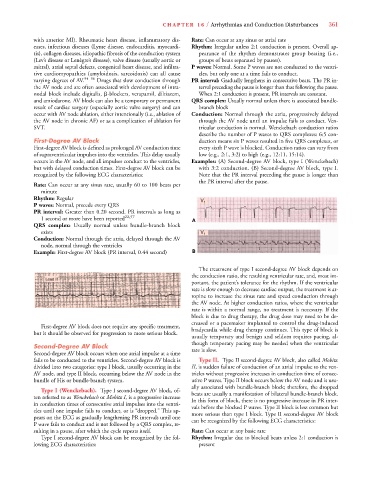
                   occurs in the AV node, and all impulses conduct to the ventricles,  Examples: (A) Second-degree AV block, type I (Wenckebach)
                   but with delayed conduction times. First-degree AV block can be  with 3:2 conduction. (B) Second-degree AV block, type I.
                   recognized by the following ECG characteristics:      Note that the PR interval preceding the pause is longer than
                                                                         the PR interval after the pause.
                   Rate: Can occur at any sinus rate, usually 60 to 100 beats per
                     minute
                   Rhythm: Regular
                                                                          V 1
                   P waves: Normal, precede every QRS
                   PR interval: Greater than 0.20 second. PR intervals as long as
                     1 second or more have been reported 22,57         A
                   QRS complex: Usually normal unless bundle-branch block
                     exists                                               V 1
                   Conduction: Normal through the atria, delayed through the AV
                     node, normal through the ventricles
                   Example: First-degree AV block (PR interval, 0.44 second)  B
                                                                         The treatment of type I second-degree AV block depends on
                                                                       the conduction ratio, the resulting ventricular rate, and, most im-
                                                                       portant, the patient’s tolerance for the rhythm. If the ventricular
                                                                       rate is slow enough to decrease cardiac output, the treatment is at-
                                                                       ropine to increase the sinus rate and speed conduction through
                                                                       the AV node. At higher conduction ratios, where the ventricular
                                                                       rate is within a normal range, no treatment is necessary. If the
                                                                       block is due to drug therapy, the drug dose may need to be de-
                                                                       creased or a pacemaker implanted to control the drug-induced
                     First-degree AV block does not require any specific treatment,
                                                                       bradycardia while drug therapy continues. This type of block is
                   but it should be observed for progression to more serious block.
                                                                       usually temporary and benign and seldom requires pacing, al-
                                                                       though temporary pacing may be needed when the ventricular
                   Second-Degree AV Block
                                                                       rate is slow.
                   Second-degree AV block occurs when one atrial impulse at a time
                   fails to be conducted to the ventricles. Second-degree AV block is  Type II.  Type II second-degree AV block, also called Mobitz
                   divided into two categories: type I block, usually occurring in the  II, is sudden failure of conduction of an atrial impulse to the ven-
                                                                       I
                                                                       I
                   AV node, and type II block, occurring below the AV node in the  tricles without progressive increases in conduction time of consec-
                   bundle of His or bundle-branch system.              utive P waves. Type II block occurs below the AV node and is usu-
                                                                       ally associated with bundle-branch block; therefore, the dropped
                     Type I (Wenckebach).  Type I second-degree AV block, of-  beats are usually a manifestation of bilateral bundle-branch block.
                                                I
                                                I
                   ten referred to as Wenckebach or Mobitz I, is a progressive increase  In this form of block, there is no progressive increase in PR inter-
                   in conduction times of consecutive atrial impulses into the ventri-  vals before the blocked P waves. Type II block is less common but
                   cles until one impulse fails to conduct, or is “dropped.” This ap-  more serious than type I block. Type II second-degree AV block
                   pears on the ECG as gradually lengthening PR intervals until one  can be recognized by the following ECG characteristics:
                   P wave fails to conduct and is not followed by a QRS complex, re-
                   sulting in a pause, after which the cycle repeats itself.  Rate: Can occur at any basic rate
                     Type I second-degree AV block can be recognized by the fol-  Rhythm: Irregular due to blocked beats unless 2:1 conduction is
                   lowing ECG characteristics:                           present

