


Page 386 - Cardiac Nursing
P. 386
6 A
                                        M
                                     6 A
                                   2:1
                                   2:1
                                          Pa
                                           g
                                          Pa
                                        M
                                          Pa
                                   1
                              /30
                              /30
                             6
                           xd
                             6
                                    1
                                   1
                                /09
                                /09
                                /09
                                           g
                                                  ara
                                                   a
                                                  ara
                                                  t
                                                  t
                                                      c.
                                                      c.
                                                     In
                                                   a
                                                     In
                                                 p
                                              62
                                              62
                                            e 3
                                           g
                                            e 3
                                                 p
                                                 p
                                                A
                                              62
                                                A
                           xd
                    33
         LWB
                      3-3
                    33
            K34
         LWBK340-c16_
                 16_
               0-c
                          q
                        87.
         LWB K34 0-c 16_ p p pp333-387.qxd  6/30/09  12:16 AM  Page 362 Aptara Inc.
                          q
                        87.
                          q
                      3-3
                  362    P A R T  III / Assessment of Heart Disease
                                                     Example of second-degree AV block, type II
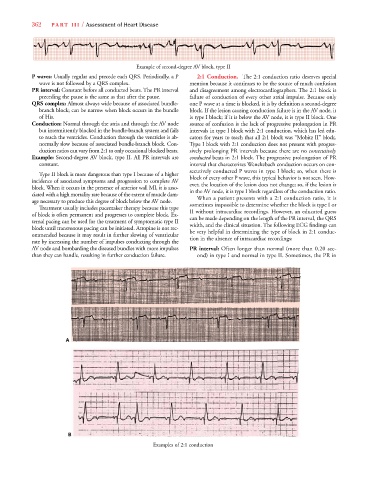
                  P waves: Usually regular and precede each QRS. Periodically, a P  2:1 Conduction.  The 2:1 conduction ratio deserves special
                     wave is not followed by a QRS complex.           mention because it continues to be the source of much confusion
                  PR interval: Constant before all conducted beats. The PR interval  and disagreement among electrocardiographers. The 2:1 block is
                     preceding the pause is the same as that after the pause.  failure of conduction of every other atrial impulse. Because only
                  QRS complex: Almost always wide because of associated bundle-  one P wave at a time is blocked, it is by definition a second-degree
                     branch block; can be narrow when block occurs in the bundle  block. If the lesion causing conduction failure is in the AV node, it
                     of His.                                          is type I block; if it is below the AV node, it is type II block. One
                  Conduction: Normal through the atria and through the AV node  source of confusion is the lack of progressive prolongation in PR
                     but intermittently blocked in the bundle-branch system and fails  intervals in type I block with 2:1 conduction, which has led edu-
                     to reach the ventricles. Conduction through the ventricles is ab-  cators for years to teach that all 2:1 block was “Mobitz II” block.
                     normally slow because of associated bundle-branch block. Con-  Type I block with 2:1 conduction does not present with progres-
                     duction ratios can vary from 2:1 to only occasional blocked beats.  sively prolonging PR intervals because there are no consecutively
                  Example: Second-degree AV block, type II. All PR intervals are  conducted beats in 2:1 block. The progressive prolongation of PR
                     constant.                                        interval that characterizes Wenckebach conduction occurs on con-
                                                                      secutively conducted P waves in type I block; so, when there is
                     Type II block is more dangerous than type I because of a higher
                  incidence of associated symptoms and progression to complete AV  block of every other P wave, this typical behavior is not seen. How-
                  block. When it occurs in the presence of anterior wall MI, it is asso-  ever, the location of the lesion does not change; so, if the lesion is
                  ciated with a high mortality rate because of the extent of muscle dam-  in the AV node, it is type I block regardless of the conduction ratio.
                  age necessary to produce this degree of block below the AV node.  When a patient presents with a 2:1 conduction ratio, it is
                     Treatment usually includes pacemaker therapy because this type  sometimes impossible to determine whether the block is type I or
                  of block is often permanent and progresses to complete block. Ex-  II without intracardiac recordings. However, an educated guess
                  ternal pacing can be used for the treatment of symptomatic type II  can be made depending on the length of the PR interval, the QRS
                  block until transvenous pacing can be initiated. Atropine is not rec-  width, and the clinical situation. The following ECG findings can
                  ommended because it may result in further slowing of ventricular  be very helpful in determining the type of block in 2:1 conduc-
                  rate by increasing the number of impulses conducting through the  tion in the absence of intracardiac recordings:
                  AV node and bombarding the diseased bundles with more impulses  PR interval: Often longer than normal (more than 0.20 sec-
                  than they can handle, resulting in further conduction failure.  ond) in type I and normal in type II. Sometimes, the PR in
                              A A

                              B B
                                                          Examples of 2:1 conduction

