


Page 404 - Cardiac Nursing
P. 404
M
                                        M
                                     6 A
                                   2:1
                                     6 A
                                           g
                                           g
                                           g
                                          Pa
                                          Pa
                                   2:1
                             6
                              /30
                             6
                           xd
                              6
                                   1
                                   1
                                /09
                              /30
                                /09
                                                   a
                                                   a
                                                  ara
                                                  t
                                                  ara
                                                      c.
                                                      c.
                                                      c.
                                                     In
                                                     In
                                                  t
                                              80
                                                A
                                              80
                                            e 3
                                            e 3
                                                 p
                                                 p
                                                 p
                                                A
                                                A
                    33
         LWBK340-c16_ p p pp333-387.qxd  6/30/09  12:16 AM  Page 380 Aptara Inc.
                    33
                      3-3
                      3-3
            K34
                 16_
                 16_
               0-c
            K34
               0-c
                          q
                        87.
                        87.
                          q
                           xd
                          q
                  380    P A R T  III / Assessment of Heart Disease
                                  V V V 1 1 1
                                A A
                                  V 1
                                B B
                                  V 1
                                C C
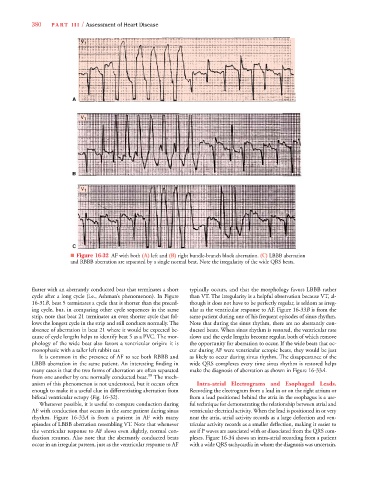
                               ■ Figure 16-32 AF with both (A) left and (B) right bundle-branch block aberration. (C) LBBB aberration
                               and RBBB aberration are separated by a single normal beat. Note the irregularity of the wide QRS beats.
                  flutter with an aberrantly conducted beat that terminates a short  typically occurs, and that the morphology favors LBBB rather
                  cycle after a long cycle (i.e., Ashman’s phenomenon). In Figure  than VT. The irregularity is a helpful observation because VT, al-
                  16-31B, beat 5 terminates a cycle that is shorter than the preced-  though it does not have to be perfectly regular, is seldom as irreg-
                  ing cycle, but, in comparing other cycle sequences in the same  ular as the ventricular response to AF. Figure 16-33B is from the
                  strip, note that beat 21 terminates an even shorter cycle that fol-  same patient during one of his frequent episodes of sinus rhythm.
                  lows the longest cycle in the strip and still conducts normally. The  Note that during the sinus rhythm, there are no aberrantly con-
                  absence of aberration in beat 21 where it would be expected be-  ducted beats. When sinus rhythm is restored, the ventricular rate
                  cause of cycle lengths helps to identify beat 5 as a PVC. The mor-  slows and the cycle lengths become regular, both of which remove
                  phology of the wide beat also favors a ventricular origin: it is  the opportunity for aberration to occur. If the wide beats that oc-
                  monophasic with a taller left rabbit ear.           cur during AF were ventricular ectopic beats, they would be just
                     It is common in the presence of AF to see both RBBB and  as likely to occur during sinus rhythm. The disappearance of the
                  LBBB aberration in the same patient. An interesting finding in  wide QRS complexes every time sinus rhythm is restored helps
                                                                                                                3
                                                                                                                3
                  many cases is that the two forms of aberration are often separated  make the diagnosis of aberration as shown in Figure 16-33A.
                                                        99
                  from one another by one normally conducted beat. The mech-
                  anism of this phenomenon is not understood, but it occurs often  Intra-atrial Electrograms and Esophageal Leads.
                  enough to make it a useful clue in differentiating aberration from  Recording the electrogram from a lead in or on the right atrium or
                  bifocal ventricular ectopy (Fig. 16-32).            from a lead positioned behind the atria in the esophagus is a use-
                     Whenever possible, it is useful to compare conduction during  ful technique for demonstrating the relationship between atrial and
                  AF with conduction that occurs in the same patient during sinus  ventricular electrical activity. When the lead is positioned in or very
                  rhythm. Figure 16-33A is  from a  patient in AF with many  near the atria, atrial activity records as a large deflection and ven-
                  episodes of LBBB aberration resembling VT. Note that whenever  tricular activity records as a smaller deflection, making it easier to
                  the ventricular response to AF slows even slightly, normal con-  see if P waves are associated with or dissociated from the QRS com-
                  duction resumes. Also note that the aberrantly conducted beats  plexes. Figure 16-34 shows an intra-atrial recording from a patient
                  occur in an irregular pattern, just as the ventricular response to AF  with a wide QRS tachycardia in whom the diagnosis was uncertain.

