


Page 405 - Cardiac Nursing
P. 405
Pa
                                          Pa
                                        M
                                        M
                                          Pa
                                           g
                                            e 3
                                           g
                                           g
                                     6 A
                                /09
                                    1
                                /09
                                /09
                                   1
                                   2:1
                                     6 A
                                   1
                                   2:1
                                                  ara
                                                   a
                                                  t
                                                  ara
                                                   a
                                                      c.
                                                      c.
                                                     In
                                                     In
                                                  t
                                              81
                                              81
                                            e 3
                                              81
                                                A
                                                 p
                                                 p
                                                A
                                                 p
                      3-3
                      3-3
                    33
                          q
                        87.
                        87.
                    33
         LWBK340-c16_
         LWB
         LWB K34 0-c 16_ p p pp333-387.qxd  6/30/09  12:16 AM  Page 381 Aptara Inc.
                 16_
               0-c
            K34
                             6
                           xd
                             6
                              /30
                          q
                              /30
                           xd
                          q
                                                             C HAPTER 1 6 / Arrhythmias and Conduction Disturbances  381
                                  V 1 1
                     A
                         V V 1
                     B
                                            A
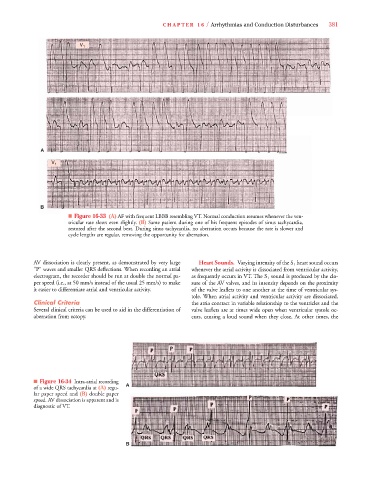
                              ■ Figure 16-33F  6 33 (A) AF with frequent LBBB resembling VT. Normal conduction resumes whenever the ven-
                              tricular rate slows even slightly. (B) Same patient during one of his frequent episodes of sinus tachycardia,
                              restored after the second beat. During sinus tachycardia, no aberration occurs because the rate is slower and
                              cycle lengths are regular, removing the opportunity for aberration.
                   AV dissociation is clearly present, as demonstrated by very large  Heart Sounds.  Varying intensity of the S 1 heart sound occurs
                   “P” waves and smaller QRS deflections. When recording an atrial  whenever the atrial activity is dissociated from ventricular activity,
                   electrogram, the recorder should be run at double the normal pa-  as frequently occurs in VT. The S 1 sound is produced by the clo-
                   per speed (i.e., at 50 mm/s instead of the usual 25 mm/s) to make  sure of the AV valves, and its intensity depends on the proximity
                   it easier to differentiate atrial and ventricular activity.  of the valve leaflets to one another at the time of ventricular sys-
                                                                       tole. When atrial activity and ventricular activity are dissociated,
                   Clinical Criteria                                   the atria contract in variable relationship to the ventricles and the
                   Several clinical criteria can be used to aid in the differentiation of  valve leaflets are at times wide open when ventricular systole oc-
                   aberration from ectopy.                             curs, causing a loud sound when they close. At other times, the


                   ■ Figure 16-34 Intra-atrial recording
                                                 A
                   of a wide QRS tachycardia at (A) regu-
                   lar paper speed and (B) double paper
                   speed. AV dissociation is apparent and is
                   diagnostic of VT.


                                                 B B

