


Page 285 - ACCCN's Critical Care Nursing
P. 285
262  P R I N C I P L E S   A N D   P R A C T I C E   O F   C R I T I C A L   C A R E


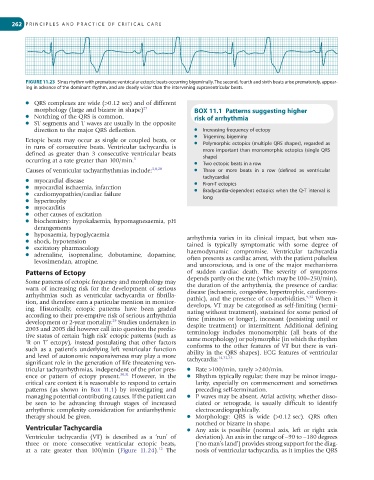
         FIGURE 11.23  Sinus rhythm with premature ventricular ectopic beats occurring bigeminally. The second, fourth and sixth beats arise prematurely, appear-
         ing in advance of the dominant rhythm, and are clearly wider than the intervening supraventricular beats.

         ●  QRS complexes are wide (>0.12 sec) and of different
            morphology (large and bizarre in shape) 27           BOX 11.1  Patterns suggesting higher
         ●  Notching of the QRS is common.                       risk of arrhythmia
         ●  ST segments and T waves are usually in the opposite
            direction to the major QRS deflection.               ●  Increasing frequency of ectopy
                                                                 ●  Trigeminy, bigeminy
         Ectopic  beats  may  occur  as  single  or  coupled  beats,  or     ●  Polymorphic ectopics (multiple QRS shapes), regarded as
         in  runs  of  consecutive  beats.  Ventricular  tachycardia  is   more important than monomorphic ectopics (single QRS
         defined  as  greater  than  3  consecutive  ventricular  beats   shape)
         occurring at a rate greater than 100/min. 5             ●  Two ectopic beats in a row
         Causes of ventricular tachyarrhythmias include: 3,8,28  ●  Three  or  more  beats  in  a  row  (defined  as  ventricular
                                                                   tachycardia)
         ●  myocardial disease                                   ●  R-on-T ectopics
         ●  myocardial ischaemia, infarction                     ●  Bradycardia-dependent ectopics when the Q-T interval is
         ●  cardiomyopathies/cardiac failure                       long
         ●  hypertrophy
         ●  myocarditis
         ●  other causes of excitation
         ●  biochemistry: hypokalaemia, hypomagnesaemia, pH
            derangements
         ●  hypoxaemia, hypoglycaemia                         arrhythmia  varies  in  its  clinical  impact,  but  when  sus-
         ●  shock, hypotension                                tained  is  typically  symptomatic  with  some  degree  of
         ●  excitatory pharmacology                           haemo dynamic  compromise.  Ventricular  tachycardia
         ●  adrenaline,  isoprenaline,  dobutamine,  dopamine,   often presents as cardiac arrest, with the patient pulseless
            levosimendan, atropine.
                                                              and unconscious, and is one of the major mechanisms
         Patterns of Ectopy                                   of  sudden  cardiac  death.  The  severity  of  symptoms
         Some patterns of ectopic frequency and morphology may   depends partly on the rate (which may be 100–250/min),
                                                              the duration of the arrhythmia, the presence of cardiac
         warn  of  increasing  risk  for  the  development  of  serious   disease (ischaemic, congestive, hypertrophic, cardiomyo-
         arrhythmias  such  as  ventricular  tachycardia  or  fibrilla-  pathic), and the presence of co-morbidities. 9,32  When it
         tion, and therefore earn a particular mention in monitor-  develops, VT may be categorised as self-limiting (termi-
         ing.  Historically,  ectopic  patterns  have  been  graded   nating without treatment), sustained for some period of
         according to their pre-emptive risk of serious arrhythmia   time  (minutes  or  longer), incessant  (persisting until  or
                                      29
         development or 2-year mortality.  Studies undertaken in   despite  treatment)  or  intermittent.  Additional  defining
         2003 and 2005 did however call into question the predic-  terminology  includes  monomorphic  (all  beats  of  the
         tive status of certain ‘high risk’ ectopic patterns (such as   same morphology) or polymorphic (in which the rhythm
         ‘R  on  T’  ectopy),  instead  postulating  that  other  factors   conforms  to  the  other  features  of  VT  but  there  is  vari-
         such  as  a  patient’s  underlying  left  ventricular  function   ability  in  the  QRS  shapes).  ECG  features  of  ventricular
         and level of autonomic responsiveness may play a more   tachycardia: 14,32,33
         significant role in the generation of life threatening ven-
         tricular tachyarrhythmias, independent of the prior pres-  ●  Rate >100/min, rarely >240/min.
         ence  or  pattern  of  ectopy  present. 30,31   However,  in  the   ●  Rhythm typically regular; there may be minor irregu-
         critical care context it is reasonable to respond to certain   larity,  especially  on  commencement  and  sometimes
         patterns  (as  shown  in  Box  11.1)  by  investigating  and   preceding self-termination.
         managing potential contributing causes. If the patient can   ●  P waves may be absent. Atrial activity, whether disso-
         be  seen  to  be  advancing  through  stages  of  increased   ciated  or  retrograde,  is  usually  difficult  to  identify
         arrhythmic complexity consideration for antiarrhythmic   electrocardiographically.
         therapy should be given.                             ●  Morphology:  QRS  is  wide  (>0.12 sec).  QRS  often
                                                                 notched or bizarre in shape.
         Ventricular Tachycardia                              ●  Any  axis  is  possible  (normal  axis,  left  or  right  axis
         Ventricular  tachycardia  (VT)  is  described  as  a  ‘run’  of   deviation). An axis in the range of −90 to −180 degrees
         three  or  more  consecutive  ventricular  ectopic  beats,     (‘no man’s land’) provides strong support for the diag-
                                                     12
         at  a  rate  greater  than  100/min  (Figure  11.24).   The   nosis of ventricular tachycardia, as it implies the QRS

