


Page 294 - ACCCN's Critical Care Nursing
P. 294
Cardiac Rhythm Assessment and Management  271


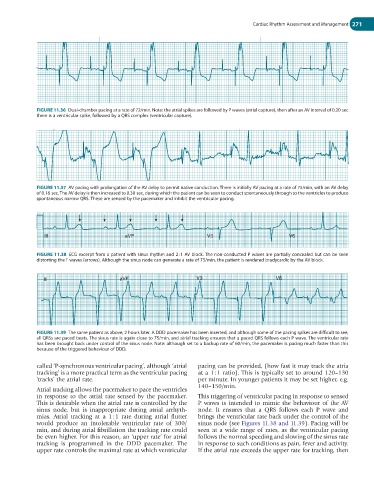
             FIGURE 11.36  Dual-chamber pacing at a rate of 72/min. Note: the atrial spikes are followed by P waves (atrial capture), then after an AV interval of 0.20 sec
             there is a ventricular spike, followed by a QRS complex (ventricular capture).


             FIGURE 11.37  AV pacing with prolongation of the AV delay to permit native conduction. There is initially AV pacing at a rate of 75/min, with an AV delay
             of 0.16 sec. The AV delay is then increased to 0.30 sec, during which the patient can be seen to conduct spontaneously through to the ventricles to produce
             spontaneous narrow QRS. These are sensed by the pacemaker and inhibit the ventricular pacing.


                III                       aVF                        V3                         V6

             FIGURE 11.38  ECG excerpt from a patient with sinus rhythm and 2 : 1 AV block. The non-conducted P waves are partially concealed but can be seen
             distorting the T waves (arrows). Although the sinus node can generate a rate of 75/min, the patient is rendered bradycardic by the AV block.


               III                      aVF                      V 3                       V 6


             FIGURE 11.39  The same patient as above, 2 hours later. A DDD pacemaker has been inserted, and although some of the pacing spikes are difficult to see,
             all QRSs are paced beats. The sinus rate is again close to 75/min, and atrial tracking ensures that a paced QRS follows each P wave. The ventricular rate
             has been brought back under control of the sinus node. Note: although set to a backup rate of 60/min, the pacemaker is pacing much faster than this
             because of the triggered behaviour of DDD.


             called ‘P-synchronous ventricular pacing’, although ‘atrial   pacing can be provided, (how fast it may track the atria
             tracking’ is a more practical term as the ventricular pacing   at a 1 : 1 ratio). This is typically set to around 120–130
             ‘tracks’ the atrial rate.                            per minute. In younger patients it may be set higher, e.g.
                                                                  140–150/min.
             Atrial tracking allows the pacemaker to pace the ventricles
             in  response  to  the  atrial  rate  sensed  by  the  pacemaker.   This triggering of ventricular pacing in response to sensed
             This is desirable when the atrial rate is controlled by the   P  waves  is  intended  to  mimic  the  behaviour  of  the  AV
             sinus  node,  but  is  inappropriate  during  atrial  arrhyth-  node.  It  ensures  that  a  QRS  follows  each  P  wave  and
             mias.  Atrial  tracking  at  a  1 : 1  rate  during  atrial  flutter   brings the ventricular rate back under the control of the
             would  produce  an  intolerable  ventricular  rate  of  300/  sinus node (see Figures 11.38 and 11.39). Pacing will be
             min, and during atrial fibrillation the tracking rate could   seen  at  a  wide  range  of  rates,  as  the  ventricular  pacing
             be even higher. For this reason, an ‘upper rate’ for atrial   follows the normal speeding and slowing of the sinus rate
             tracking  is  programmed  in  the  DDD  pacemaker.  The   in response to such conditions as pain, fever and activity.
             upper rate controls the maximal rate at which ventricular   If the atrial rate exceeds the upper rate for tracking, then

