


Page 292 - ACCCN's Critical Care Nursing
P. 292
Cardiac Rhythm Assessment and Management  269


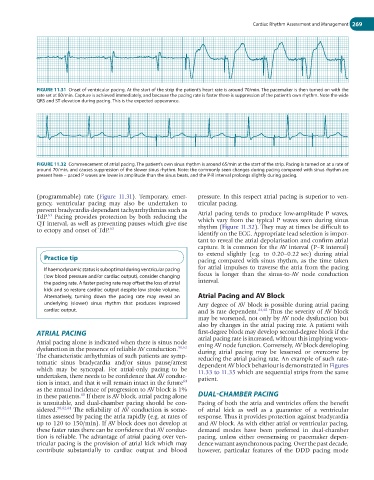
             FIGURE 11.31  Onset of ventricular pacing. At the start of the strip the patient’s heart rate is around 70/min. The pacemaker is then turned on with the
             rate set at 80/min. Capture is achieved immediately, and because the pacing rate is faster there is suppression of the patient’s own rhythm. Note the wide
             QRS and ST elevation during pacing. This is the expected appearance.


             FIGURE 11.32  Commencement of atrial pacing. The patient’s own sinus rhythm is around 65/min at the start of the strip. Pacing is turned on at a rate of
             around 70/min, and causes suppression of the slower sinus rhythm. Note: the commonly seen changes during pacing compared with sinus rhythm are
             present here – paced P waves are lower in amplitude than the sinus beats, and the P-R interval prolongs slightly during pacing.


             (programmable)  rate  (Figure  11.31).  Temporary,  emer-  pressure. In this respect atrial pacing is superior to ven-
             gency,  ventricular  pacing  may  also  be  undertaken  to   tricular pacing.
             prevent bradycardia-dependant tachyarrhythmias such as   Atrial  pacing  tends  to  produce  low-amplitude  P  waves,
                 63
             TdP.   Pacing  provides  protection  by  both  reducing  the   which  vary  from  the  typical  P  waves  seen  during  sinus
             QT interval, as well as preventing pauses which give rise   rhythm (Figure 11.32). They may at times be difficult to
             to ectopy and onset of TdP. 63
                                                                  identify on the ECG. Appropriate lead selection is impor-
                                                                  tant to reveal the atrial depolarisation and confirm atrial
                                                                  capture. It is common for the AV interval (P–R interval)
                                                                  to  extend  slightly  (e.g.  to  0.20–0.22 sec)  during  atrial
               Practice tip                                       pacing compared with sinus rhythm, as the time taken
               If haemodynamic status is suboptimal during ventricular pacing   for atrial impulses to traverse the atria from the pacing
               (low blood pressure and/or cardiac output), consider changing   focus  is  longer  than  the  sinus-to-AV  node  conduction
               the pacing rate. A faster pacing rate may offset the loss of atrial   interval.
               kick and so restore cardiac output despite low stroke volume.
               Alternatively,  turning  down  the  pacing  rate  may  reveal  an   Atrial Pacing and AV Block
               underlying  (slower)  sinus  rhythm  that  produces  improved   Any degree of AV block is possible during atrial pacing
               cardiac output.                                    and is rate dependent. 64,65  Thus the severity of AV block
                                                                  may be worsened, not only by AV node dysfunction but
                                                                  also by changes in the atrial pacing rate. A patient with
             ATRIAL PACING                                        first-degree block may develop second-degree block if the
                                                                  atrial pacing rate is increased, without this implying wors-
             Atrial pacing alone is indicated when there is sinus node   ening AV node function. Conversely, AV block developing
             dysfunction in the presence of reliable AV conduction. 50,62    during  atrial  pacing  may  be  lessened  or  overcome  by
             The characteristic arrhythmias of such patients are symp-  reducing the atrial pacing rate. An example of such rate-
             tomatic  sinus  bradycardia  and/or  sinus  pause/arrest   dependent AV block behaviour is demonstrated in Figures
             which  may  be  syncopal.  For  atrial-only  pacing  to  be   11.33 to 11.35 which are sequential strips from the same
             undertaken, there needs to be confidence that AV conduc-  patient.
                                                             64
             tion is intact, and that it will remain intact in the future
             as the annual incidence of progression to AV block is 1%
                           65
             in these patients.  If there is AV block, atrial pacing alone   DUAL-CHAMBER PACING
             is unsuitable, and dual-chamber pacing should be con-  Pacing of both the atria and ventricles offers the benefit
             sidered. 50,62,64   The  reliability  of  AV  conduction  is  some-  of  atrial  kick  as  well  as  a  guarantee  of  a  ventricular
             times assessed by pacing the atria rapidly (e.g. at rates of   response. Thus it provides protection against bradycardia
             up to 120 to 150/min). If AV block does not develop at   and AV block. As with either atrial or ventricular pacing,
             these faster rates there can be confidence that AV conduc-  demand  modes  have  been  preferred  in  dual-chamber
             tion is reliable. The advantage of atrial pacing over ven-  pacing,  unless  either  oversensing  or  pacemaker  depen-
             tricular pacing is the provision of atrial kick which may   dence warrant asynchronous pacing. Over the past decade,
             contribute  substantially  to  cardiac  output  and  blood   however,  particular  features  of  the  DDD  pacing  mode

