


Page 293 - ACCCN's Critical Care Nursing
P. 293
270  P R I N C I P L E S   A N D   P R A C T I C E   O F   C R I T I C A L   C A R E


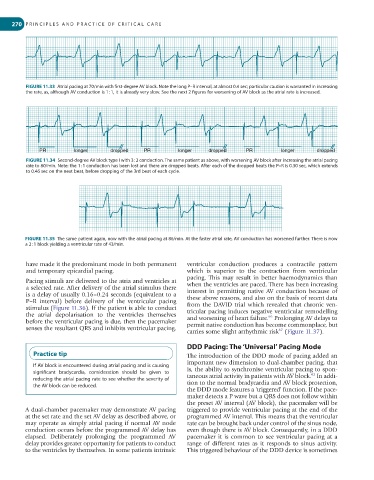
         FIGURE 11.33  Atrial pacing at 70/min with first-degree AV block. Note the long P–R interval, at almost 0.4 sec; particular caution is warranted in increasing
         the rate, as, although AV conduction is 1 : 1, it is already very slow. See the next 2 figures for worsening of AV block as the atrial rate is increased.


              PR         longer      dropped    PR         longer    dropped     PR          longer      dropped
         FIGURE 11.34  Second-degree AV block type I with 3 : 2 conduction. The same patient as above, with worsening AV block after increasing the atrial pacing
         rate to 80/min. Note: the 1 : 1 conduction has been lost and there are dropped beats. After each of the dropped beats the P–R is 0.30 sec, which extends
         to 0.46 sec on the next beat, before dropping of the 3rd beat of each cycle.


         FIGURE 11.35  The same patient again, now with the atrial pacing at 86/min. At the faster atrial rate, AV conduction has worsened further. There is now
         a 2 : 1 block yielding a ventricular rate of 43/min.


         have made it the predominant mode in both permanent   ventricular  conduction  produces  a  contractile  pattern
         and temporary epicardial pacing.                     which  is  superior  to  the  contraction  from  ventricular
                                                              pacing.  This  may  result  in  better  haemodynamics  than
         Pacing stimuli are delivered to the atria and ventricles at   when the ventricles are paced. There has been increasing
         a selected rate. After delivery of the atrial stimulus there   interest  in  permitting  native  AV  conduction  because  of
         is a delay of usually 0.16–0.24 seconds (equivalent to a   these above reasons, and also on the basis of recent data
         P–R  interval)  before  delivery  of  the  ventricular  pacing   from  the  DAVID  trial  which  revealed  that  chronic  ven-
         stimulus (Figure 11.36). If the patient is able to conduct   tricular pacing induces negative ventricular remodelling
         the  atrial  depolarisation  to  the  ventricles  themselves   and worsening of heart failure.  Prolonging AV delays to
                                                                                         66
         before the ventricular pacing is due, then the pacemaker   permit native conduction has become commonplace, but
         senses the resultant QRS and inhibits ventricular pacing.
                                                              carries some slight arrhythmic risk  (Figure 11.37).
                                                                                            67
                                                              DDD Pacing: The ‘Universal’ Pacing Mode
            Practice tip                                      The introduction of the DDD mode of pacing added an
                                                              important new dimension to dual-chamber pacing, that
            If AV block is encountered during atrial pacing and is causing
            significant  bradycardia,  consideration  should  be  given  to   is, the ability to synchronise ventricular pacing to spon-
                                                                                                       62
            reducing the atrial pacing rate to see whether the severity of   taneous atrial activity in patients with AV block.  In addi-
            the AV block can be reduced.                      tion to the normal bradycardia and AV block protection,
                                                              the DDD mode features a ‘triggered’ function. If the pace-
                                                              maker detects a P wave but a QRS does not follow within
                                                              the preset AV interval (AV block), the pacemaker will be
         A dual-chamber pacemaker may demonstrate AV pacing   triggered to provide ventricular pacing at the end of the
         at the set rate and the set AV delay as described above, or   programmed AV interval. This means that the ventricular
         may operate as simply atrial pacing if normal AV node   rate can be brought back under control of the sinus node,
         conduction occurs before the programmed AV delay has   even though there is AV block. Consequently, in a DDD
         elapsed.  Deliberately  prolonging  the  programmed  AV   pacemaker  it  is  common  to  see  ventricular  pacing  at  a
         delay provides greater opportunity for patients to conduct   range  of  different  rates  as  it  responds  to  sinus  activity.
         to the ventricles by themselves. In some patients intrinsic   This triggered behaviour of the DDD device is sometimes

